Event content repurposing is the strategic process of transforming live event recordings, transcripts, and session materials into multiple derivative content assets, such as blog posts, social media clips, whitepapers, podcast episodes, and training modules, that extend the value and reach of the original event far beyond its live audience. Unlike general content repurposing, event content repurposing deals specifically with the high-value, time-bound knowledge generated at conferences, summits, and professional gatherings.
Why Event Content Repurposing Matters Now
A three-day conference with 40 sessions generates hundreds of hours of expert discussion, strategic insight, and practitioner knowledge. Medical conference research shows that attendee retention drops to just 14.9% within three days and 11.3% at 90 days (Event Tech Live). The vast majority of what gets said at your event disappears from memory almost immediately.
The economics make repurposing unavoidable. The global events industry is projected to reach $2.5 trillion by 2035, growing at 6.8% CAGR (Allied Market Research). Organizations are spending more on events than ever. Yet most treat event content as disposable.
Content repurposing strategies improve ROI by 32% on average, and repurposing can increase results by 75% without a proportional increase in investment (SQ Magazine). For event professionals, those numbers translate directly to justifying event budgets and demonstrating value to stakeholders.
Understanding Event Content Repurposing
Event content repurposing goes beyond simply uploading session recordings to a portal. It involves systematically breaking down event content into its component ideas, insights, and data points, then reconstructing those elements into formats optimized for different channels, audiences, and stages of the buyer journey.
The raw materials for event content repurposing include session recordings, transcripts, presentation slides, Q&A exchanges, panel discussions, and workshop outputs. Each can yield multiple derivative assets. A single 45-minute keynote can produce a full blog post, 5-10 social media quotes, a short-form video highlight reel, a podcast episode, an infographic, and FAQ content derived from the Q&A.
Organizations that repurpose event content systematically can generate 20-30 distinct assets from a single session, and more than 300 pieces across a multi-session event when using AI-powered workflows.
How Event Content Repurposing Works
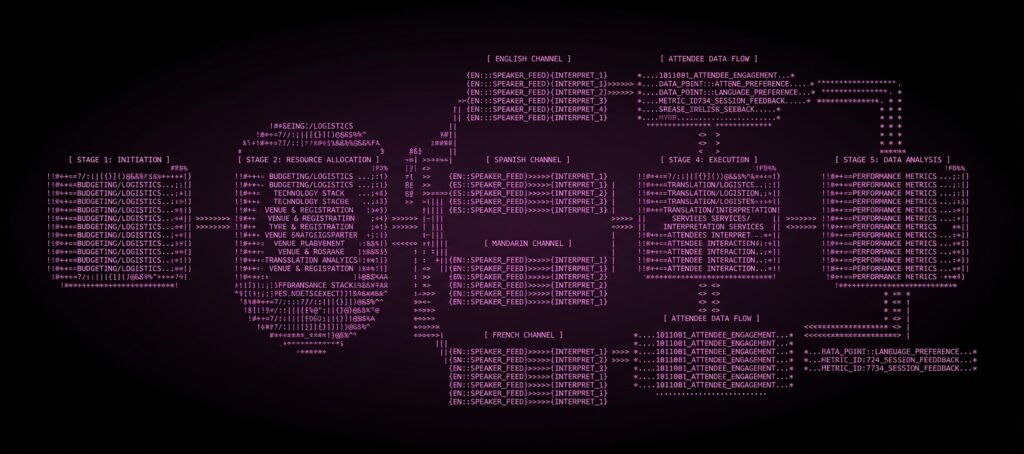
The repurposing process follows a pipeline with four stages: capture, process, transform, and distribute.
Stage 1: Capture
Every repurposing pipeline begins with capturing the raw event content. The quality of what you capture determines the quality of everything downstream.
- Audio/video recording of all sessions (not just mainstage)
- Real-time transcription to create text-based source material
- Speaker slides and supplementary materials
- Audience interaction data (polls, Q&A, chat)
Stage 2: Process
- Transcription cleanup (correcting technical terms, speaker identification)
- Content indexing (tagging by topic, speaker, theme)
- Key moment identification (quotable insights, data points, debate moments)
- Summary generation (executive-level overviews of each session)
Stage 3: Transform
- Long-form written content: Blog posts, articles, whitepapers built from session insights
- Short-form social content: Quote cards, key statistics, provocative takeaways
- Video content: Highlight reels, speaker clips, topic compilations
- Audio content: Podcast episodes with session excerpts and commentary
- Training content: Course modules, certification materials, workshop guides
- Email content: Newsletter sections, drip campaign content, attendee follow-ups
Stage 4: Distribute
- Immediate (same day): Social media highlights, attendee recap emails
- Short-term (1-2 weeks): Blog posts, podcast episodes, video highlights
- Medium-term (1-3 months): Whitepapers, training modules, ebooks
- Long-term (3-12 months): Evergreen reference content, SEO articles, certification materials
The key insight: A well-built repurposing pipeline extends a three-day conference into 6-12 months of content. The event is the beginning of the content lifecycle, not the end.
Event Content Repurposing vs. Session Recording
Many organizations confuse recording sessions with repurposing content. They are fundamentally different activities.
| Dimension | Session Recording | Event Content Repurposing |
|---|---|---|
| Output | 1 video file per session | 20-30+ assets per session |
| Audience reach | Attendees who rewatch | New audiences across channels |
| Content lifespan | Days to weeks | Months to years |
| ROI measurability | View count only | Leads, traffic, engagement, shares |
| Resource requirement | AV team | Content strategy + AI tools |
The takeaway: Session recording is a prerequisite for repurposing, not a substitute. Recording without repurposing is like harvesting wheat and leaving it in the field. You did the hard part. But without processing, the value never reaches anyone.
Getting Started with Event Content Repurposing
Start by auditing your current capture, defining your asset map, investing in transcription and indexing, choosing your technology, and building a distribution calendar that extends 3-6 months beyond the event.
Snapsight pioneered autonomous event content capture and intelligence, processing 10,415+ sessions across 627+ events in 75+ languages. The platform’s AI agents operate 91% autonomously, turning live event content into structured, repurposable assets without manual intervention. See how Snapsight powers event content repurposing.
The number depends on event size and the tools you use. A single 45-minute session can produce 10-15 assets manually or 20-30 with AI assistance: a blog summary, 5-10 social posts, quote graphics, a newsletter section, video clips, and more. Across a multi-session event, AI-powered platforms can generate over 300 individual content pieces. The constraint is not production capacity but distribution capacity and quality control.
Content repurposing strategies improve ROI by 32% on average and can increase results by 75% without proportional investment increases. For events specifically, repurposing extends the content lifespan from days to months, reaching audiences 10-50x larger than the live audience. The ROI compounds when repurposed content generates organic search traffic, social engagement, and lead generation that would otherwise require net-new content production.
Yes. Speaker agreements should explicitly address content repurposing rights. Most event speaker contracts already include recording permissions, but repurposing (creating derivative works) may require additional language. Best practice is to include repurposing rights in your standard speaker agreement, specifying that session content may be used to create blog posts, social content, training materials, and other derivative assets. Speakers generally agree because repurposing amplifies their own visibility and thought leadership.
The optimal publishing cadence follows a curve. Social media highlights and session recaps should go live within 24-48 hours while the event is still culturally relevant. Blog posts and articles perform best in the 1-4 week window. Deeper assets like whitepapers and training modules can be published 1-3 months later. Evergreen reference content can be published any time within the following year. The goal is to maintain a steady content cadence, not to dump everything at once.
At minimum, you need recording infrastructure and transcription software. For scale, you need an AI-powered platform that handles multi-track capture, automatic transcription, content summarization, and ideally derivative content generation. Platforms vary from basic transcription services (adequate for small events) to comprehensive event content intelligence platforms like Snapsight that autonomously capture, process, and prepare content for repurposing across 75+ languages and multiple simultaneous tracks.