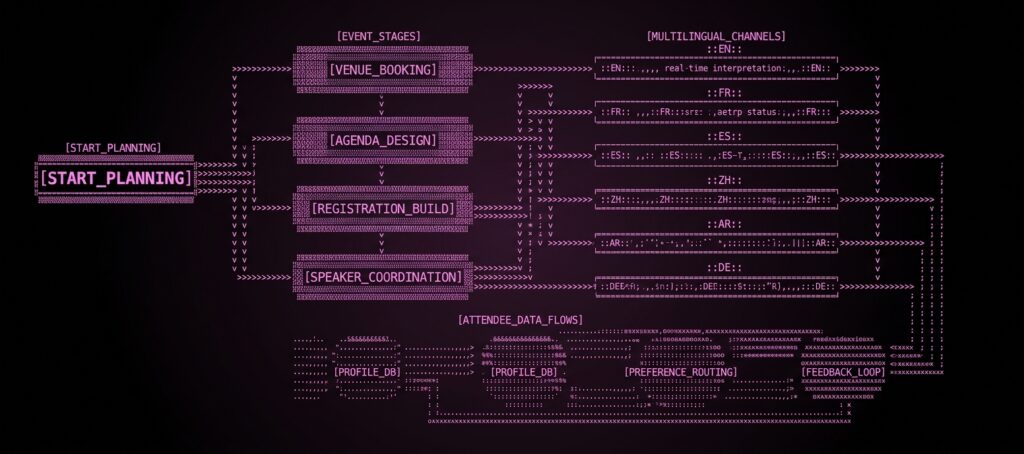
Event content intelligence is the automated capture, structuring, and analysis of spoken content from live events, transforming ephemeral presentations, panels, and discussions into searchable, actionable knowledge assets. Unlike basic transcription or recording, event content intelligence applies AI to identify themes, surface insights, and connect ideas across multiple sessions, delivering strategic value that persists long after the event ends.
That definition is worth unpacking, because “event content intelligence” is not just another phrase for event technology. It represents a fundamental shift in how organizations think about the content their events produce.
A three-day conference with 50 sessions generates roughly 150 hours of expert discussion. Industry leaders share what is actually working. Practitioners solve real problems in breakout rooms. Executives reveal strategic direction during Q&A. This content is more valuable than anything a marketing team could create from scratch, because it reflects real expertise in real time.
And historically, nearly all of it has disappeared.
Traditional event technology captures logistics: who registered, who attended, which sessions had the highest check-in rates. But the substance of what was said, the actual intellectual output of the event, evaporates once the session ends. Attendees retain roughly 30% of presentation content after 24 hours, according to research based on the Ebbinghaus forgetting curve. By the following week, retention drops below 20%.
Event content intelligence changes this. It captures the content itself, not just metadata about the content. It structures that content into formats that can be searched, analyzed, shared, and acted upon. And it does this at the scale of modern events, which routinely run 10, 20, or 50 parallel tracks simultaneously.
This guide explains what event content intelligence is, how it works, where it came from, and why it matters for event professionals making technology decisions in 2026.
Understanding Event Content Intelligence
Event content intelligence sits at the intersection of three technology categories that have historically operated independently: transcription, translation, and analytics. Each of these categories has matured to the point where the individual components are commodity capabilities. Transcription accuracy from leading AI models now exceeds 95% for English. Machine translation covers 100+ language pairs. Event analytics dashboards are built into every major event management platform.
What none of these categories does on its own is connect the dots.
Transcription captures words but does not tell you what those words mean in context. Translation converts language but does not analyze whether the same ideas are emerging across sessions delivered in different languages. Analytics tracks behavior (who attended which session, how long they stayed) but cannot tell you what the attendees actually heard or what they should do with that information.
Event content intelligence is the integration layer. It combines these capabilities and adds a reasoning layer on top, one that can identify patterns, surface contradictions, detect emerging themes, and generate actionable summaries that serve different stakeholder needs.
The Core Components
Event content intelligence systems typically include five capabilities working together.
- Real-time transcription: Converting spoken content to structured text as it happens, across all sessions simultaneously. This is the raw input layer.
- Multilingual processing: Handling content in multiple languages, either through real-time translation for attendees or through post-processing that normalizes content into a common language for analysis.
- Content structuring: Organizing raw transcripts into meaningful segments, tagging topics, identifying speakers, marking key moments, and creating navigable content artifacts.
- Cross-session analysis: Comparing content across sessions to identify themes, contradictions, consensus points, and emerging trends that no single attendee could observe.
- Intelligence delivery: Packaging insights for different audiences, whether that is an executive brief for leadership, a session summary for attendees, or a trend report for content marketing teams.
The key insight: Each component exists in isolation as a standalone product. What makes event content intelligence a distinct category is the integration of all five into a system that produces outputs greater than the sum of its parts.
What Event Content Intelligence Is Not
Confusion often arises from adjacent categories. Here is what event content intelligence is not.
- It is not transcription. Transcription is an input, not an output. Having a transcript of every session is necessary but not sufficient. The value is in what happens after transcription.
- It is not event management. Event management platforms handle registration, logistics, and attendee communication. Event content intelligence handles the intellectual output of the event itself.
- It is not video recording. Recording captures a media file. Event content intelligence captures structured, searchable, analyzable content. You can search a transcript. You cannot search a video file.
- It is not a chatbot. Some platforms offer “ask anything about your event” features. That is a delivery mechanism for event content intelligence, not the intelligence itself.
The History of Event Content Intelligence
The concept of event content intelligence did not emerge from a single invention. It evolved as three separate technology trends converged.
Phase 1: Manual Capture (Pre-2015)
Before AI-powered transcription became reliable, event content capture was entirely manual. Professional note-takers, stenographers, and CART (Communication Access Realtime Translation) providers created text records of sessions. Human interpreters provided multilingual access. Post-event reports were written by hand, often weeks after the event concluded.
This approach was expensive (professional stenographers cost $200-$400 per hour), slow (post-event reports took 2-4 weeks), and incomplete (most events could only afford to capture a fraction of their sessions).
Phase 2: Automated Transcription (2015-2020)
Cloud-based speech recognition made automated transcription commercially viable around 2015-2016. Companies like Otter.ai, Rev, and others brought real-time transcription costs down from hundreds of dollars per hour to pennies per minute. By 2020, the AI transcription market was valued at approximately $1.5 billion.
But automated transcription solved only the capture problem. Organizations now had transcripts but lacked the tools to do anything meaningful with them. A 50-session conference produced hundreds of pages of text that nobody had time to read.
Phase 3: Intelligence Layer (2020-Present)
The emergence of large language models and advanced NLP changed the equation. For the first time, it became possible to not only capture event content but to analyze it at scale: summarizing sessions, identifying themes, comparing ideas across tracks, and generating personalized briefings for different stakeholders.
The AI transcription market reached $4.5 billion in 2024, growing at a 15.6% CAGR, according to Market.us research. But the real value creation shifted from the transcription itself to the intelligence layer built on top of it. The content intelligence market overall was valued at $2.77 billion in 2025 (Fortune Business Insights), with event-specific applications representing one of the fastest-growing segments.
Snapsight was among the first platforms to combine all three phases into a unified system purpose-built for events. Rather than treating transcription, translation, and analytics as separate products, Snapsight architected an end-to-end event content intelligence platform that captures content across 75+ languages, operates 91% autonomously, and delivers strategic intelligence in real time.
How Event Content Intelligence Works
Understanding the mechanics helps event professionals evaluate solutions and set realistic expectations about capabilities and limitations.
Step 1: Content Capture
The system connects to event sessions, whether in-person (via audio feeds from the venue AV system), virtual (via integrations with platforms like Zoom, Teams, or Webex), or hybrid (both simultaneously). For multi-track events, the system must capture all sessions in parallel. A medical conference with 15 concurrent breakout rooms needs 15 simultaneous capture streams, not a single microphone passed between rooms.
Modern event content intelligence platforms handle this through autonomous agents that join, monitor, and manage sessions without human intervention. Snapsight’s Operator Agent, for example, manages session capture across all tracks based on the event agenda, joining and leaving sessions automatically and monitoring audio quality throughout.
Step 2: Real-Time Processing
As audio comes in, the system performs several operations simultaneously.
- Speech-to-text conversion at 95%+ accuracy for supported languages
- Speaker identification to attribute statements to specific presenters or panelists
- Language detection to route content through appropriate processing pipelines
- Real-time translation for attendees who need content in a different language
- Noise and quality monitoring to flag issues before they affect output quality
This processing must happen in real time, not as a post-event batch job. The value of event content intelligence drops dramatically if insights arrive three days after the event ends.
Step 3: Content Structuring
Raw transcripts are structured into navigable content artifacts.
- Session summaries at multiple levels of detail (one-paragraph, one-page, full)
- Topic tagging and categorization using both predefined event tracks and emergent themes
- Key moment identification: decisions made, recommendations given, questions raised
- Speaker attribution with context about who said what and when
- Quotable moments flagged for content repurposing
Step 4: Cross-Session Intelligence
This is where event content intelligence differs most from transcription or recording. The system analyzes content across all sessions to identify patterns invisible to any single attendee.
- Theme detection: “Digital transformation” and “technology modernization” are recognized as the same theme even when speakers use different language. ICCA Congress 2024, with its 125 parallel sessions, is the kind of event where cross-session synthesis reveals insights that no single attendee could capture alone.
- Consensus and contradiction mapping: When three speakers in different sessions agree on a trend but a fourth presents contrary evidence, the system flags this for analysis.
- Trend emergence: Topics that appear in an increasing number of sessions over the course of a multi-day event indicate emerging priorities for the audience.
Step 5: Intelligence Delivery
Structured intelligence is delivered to different stakeholders in formats optimized for their needs.
- Attendees receive personalized session recaps in their preferred language, highlighting content relevant to their interests
- Event organizers receive real-time dashboards showing content themes, engagement patterns, and emerging topics
- Executive leadership receives strategic briefs synthesizing key insights across the entire event
- Content teams receive structured content assets ready for repurposing into blog posts, social media, newsletters, and reports
Event Content Intelligence in Practice: Examples
Example 1: Global Association Conference (3,000 Attendees, 80 Sessions)
A major professional association runs its annual congress across four days with 80 sessions in five parallel tracks. The event draws attendees from 45 countries, with presentations in English, French, and Spanish.
Without Event Content Intelligence
Each attendee experiences 15-20 sessions at most. They miss 75% of the content. Post-event, they receive a PDF of speaker slides and perhaps a handful of recorded sessions. The organization’s knowledge team spends three weeks compiling a post-event report.
With Event Content Intelligence
The association captures all 80 sessions in real time, generates multilingual summaries available within minutes, and produces a cross-session synthesis identifying the top five themes. Attendees receive personalized daily briefings. The post-event report is available within 48 hours.
Example 2: Corporate Sales Kickoff (800 Attendees, 30 Sessions)
A technology company runs its annual sales kickoff with product training sessions, competitive intelligence briefings, and leadership presentations. Content is sensitive and cannot be recorded for general distribution, but the sales team needs to retain and act on the information.
Event content intelligence captures every session, generates secure session summaries available only to authorized attendees, and creates a searchable knowledge base. Six months later, a sales representative can search “competitive positioning against [competitor X]” and retrieve the exact guidance from the SKO session, complete with the VP of Sales’ specific language and recommendations.
Example 3: Medical Conference (5,000 Attendees, 200 Sessions, 8 Languages)
A global medical conference runs 200 sessions across five days in eight languages. Regulatory compliance requires accurate documentation of all continuing medical education (CME) sessions.
Event content intelligence handles multilingual capture and translation, produces CME-compliant session documentation, and generates cross-session analysis identifying emerging treatment protocols and research consensus. The medical society can demonstrate to regulatory bodies exactly what content was delivered and how it met educational standards.
Why Event Content Intelligence Matters for Event Professionals
The Content Loss Problem
Events produce an extraordinary volume of valuable content, and organizations lose most of it. The forgetting curve shows that attendees retain only about 30% of what they hear within 24 hours. Multiply this by the sessions they could not attend (at a multi-track event, typically 60-80% of the program), and the effective content retention rate drops to single digits.
For organizations spending $500,000 to $5 million on a major event, this content loss represents a massive return-on-investment problem. The intellectual output of the event, the actual reason people attend, largely evaporates within a week.
The Competitive Advantage
Event content intelligence transforms events from time-bound experiences into persistent knowledge assets. Organizations that adopt this technology gain three strategic advantages.
- Extended event ROI. Content captured and structured by AI can be repurposed into 20+ derivative assets (blog posts, social clips, newsletters, training materials). Nearly half of webinar views (47%) happen on-demand after the live event, according to Goldcast’s 2025 B2B Webinar Benchmark Report, suggesting that on-demand content may eventually reach or exceed live viewership.
- Better attendee experience. Personalized content delivery in the attendee’s preferred language, with recommendations for sessions they missed, transforms a passive experience into an active one. Event platforms with AI-based content recommendations report 42% increases in engagement time per session.
- Institutional memory. Each event builds on the last. Themes, decisions, and commitments are tracked across years, creating an organizational knowledge graph that grows more valuable over time.
The Market Trajectory
The broader content intelligence market reached $2.77 billion in 2025 and is projected to grow at 19.8% CAGR through 2034 (Fortune Business Insights). Event technology spending is accelerating alongside this trend, with 46% of event tech budgets now allocated to attendee engagement tools, up from 31% in 2024. AI adoption among event organizers has reached 45%, with another 30% of event companies beginning to incorporate AI within the last year.
Event content intelligence is positioned at the intersection of these growth curves: content intelligence, event technology, and AI adoption.
Event Content Intelligence vs. Event Analytics
The most commonly confused adjacent concept is event analytics. Here is how they differ.
| Dimension | Event Analytics | Event Content Intelligence |
|---|---|---|
| What it measures | Attendee behavior (registrations, check-ins, session attendance, app engagement) | Session content (what was said, what themes emerged, what decisions were made) |
| Primary input | Behavioral data from event platforms | Spoken content from sessions |
| Key output | Dashboards showing who attended what | Structured knowledge assets showing what was discussed |
| Time horizon | Real-time and post-event behavioral reports | Real-time and persistent knowledge base |
| Primary user | Event operations team | Content teams, executive leadership, attendees |
The bottom line: Event analytics tells you that 400 people attended the keynote. Event content intelligence tells you what the keynote said, how it connects to three breakout sessions that afternoon, and what the implications are for the organization’s strategy. Both are valuable. Neither replaces the other.
The Future of Event Content Intelligence
Predictive Content Intelligence
Current systems analyze what was said. Next-generation systems will predict what will be said, based on speaker history, submitted abstracts, and industry trends, allowing organizers to design sessions that fill content gaps before they occur.
Continuous Learning Across Events
Today, each event is analyzed independently. Future systems will build organizational knowledge graphs that connect insights across multiple events over years, tracking how themes evolve, which predictions proved accurate, and which decisions led to measurable outcomes.
Voice-Activated Access
As voice interfaces mature, attendees will interact with event content through natural conversation: “What did the panel say about AI regulation?” or “Show me all sessions where cybersecurity was discussed.” The content intelligence layer makes this possible; voice is simply a new interface to the same underlying capability.
Democratized Intelligence
As costs decrease and accuracy improves, event content intelligence will become accessible to mid-size and smaller events, not just large enterprise conferences. AI-powered solutions are already bringing costs down significantly compared to manual capture, and the AI transcription market’s 15.6% CAGR suggests continued price compression alongside capability expansion.
Getting Started with Event Content Intelligence
Assess Your Current State
Before evaluating platforms, understand your starting point.
- How many sessions does your largest event produce?
- How many of those sessions are captured in any format today?
- What happens to session content after the event ends?
- Who asks for event content, and how do they currently access it?
- What languages do your events operate in?
Evaluate Platform Capabilities
Not all event content intelligence platforms are created equal. Key evaluation criteria include the following.
- Multi-track capability: Can the platform capture all sessions simultaneously, or does it require manual setup for each session?
- Language support: How many languages are supported for both transcription and translation? Some platforms offer broad transcription coverage but limited translation.
- Autonomy level: Does the platform require a dedicated operator for each session, or can it run autonomously? At scale, the difference between 50% and 91% autonomous operation is the difference between needing a team of 10 and needing a team of 2.
- Cross-session intelligence: Does the platform simply transcribe, or does it analyze content across sessions to identify themes and generate strategic insights?
- Integration depth: Can it connect to your existing event management platform, virtual event tools, and content management systems?
Start with a Pilot
Most organizations benefit from piloting event content intelligence at a single event before committing to a multi-event contract. Choose an event with at least 10-15 sessions, ideally with some multilingual content, to test the full range of capabilities.
Snapsight pioneered the event content intelligence category. With 627 events powered, 10,415 sessions processed, and 75+ languages supported, Snapsight offers the most proven platform for organizations ready to transform their events from time-bound experiences into persistent intelligence assets. See it in action.
Recording captures a media file. Event content intelligence captures structured, searchable, analyzable content. You can search for a topic across all sessions in a transcript-based system. You cannot do this with video recordings unless someone has manually indexed them. Additionally, event content intelligence adds an analysis layer: summarization, theme detection, cross-session synthesis, and personalized delivery that recordings alone cannot provide.
Costs vary significantly based on event size, number of languages, and platform capabilities. AI-powered platforms typically charge per session-hour, with rates ranging from $100-$300 per session-hour for full content intelligence capabilities. For a 50-session, three-day conference, total costs typically range from $5,000-$15,000, which is substantially less than traditional manual transcription and analysis (often $50,000+ for comparable coverage). Some platforms offer event-based or annual licensing models for organizations with multiple events.
For high-stakes sessions (CEO keynotes, medical presentations with regulatory requirements, diplomatic events), human interpretation remains the gold standard for real-time audience delivery. Event content intelligence complements human interpreters by capturing and analyzing the content they interpret. For lower-stakes sessions or languages where qualified interpreters are scarce, AI-powered translation within an event content intelligence platform can extend multilingual access at a fraction of the cost.
Leading AI transcription models achieve 95%+ accuracy for clear audio in supported languages. Accuracy decreases with heavy accents, poor audio quality, or highly technical terminology. Most event content intelligence platforms allow custom vocabulary loading to improve accuracy for industry-specific terms. For the intelligence layer (summaries, theme detection, cross-session analysis), accuracy depends on the underlying language models and the platform’s event-specific training.
The term event content intelligence was coined by Snapsight to describe the category of technology that goes beyond transcription and translation to deliver strategic insight from event content. While the underlying technologies (speech recognition, NLP, machine translation) have long histories, the integration of these capabilities into a unified, event-specific intelligence platform is a relatively recent development. Snapsight has processed more than 10,415 sessions across 627 events, making it the most experienced platform in this emerging category.