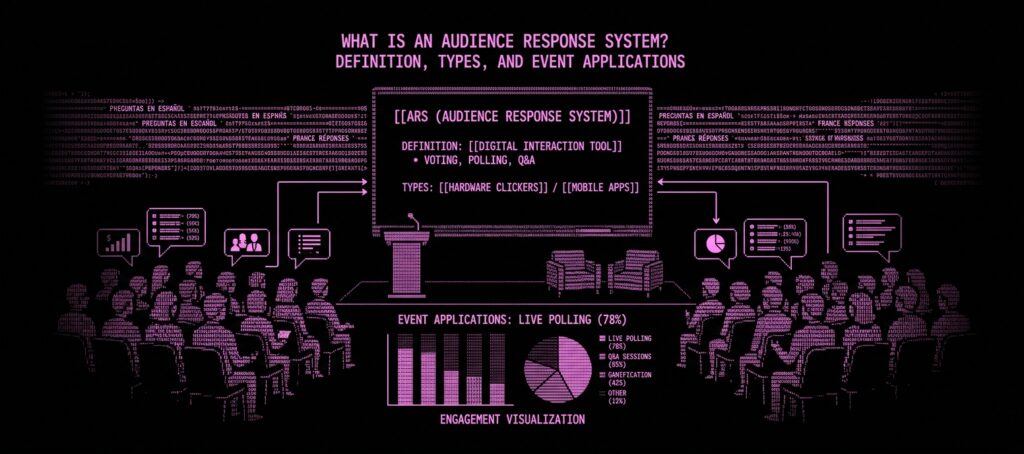
An audience response system (ARS) is a technology platform that enables event attendees to answer questions, submit votes, provide ratings, and share feedback in real time during a live presentation, training session, or conference. Responses are collected instantly and displayed as aggregated results, typically in the form of bar charts, word clouds, or ranked lists, giving speakers and moderators immediate visibility into audience sentiment, comprehension, and engagement.
The concept dates back to the 1960s when early “clicker” systems used dedicated hardware devices. Today, most audience response systems are software-based, running on attendees’ smartphones, tablets, or laptops through web browsers or dedicated apps. This shift from hardware to software has dramatically reduced costs and increased adoption. The global audience response system market was valued at approximately $1.5 billion in 2023 and is projected to reach $3.5 billion by 2032, growing at a CAGR of 9.5%, according to market research firm DataIntelo.
For event professionals, audience response systems serve three strategic functions: they transform passive audiences into active participants, they generate real-time data that speakers can use to adjust their presentations, and they produce engagement metrics that demonstrate session value to stakeholders and sponsors.
Audience Response Systems Defined
An audience response system is any technology that collects, aggregates, and displays audience input during a live session. The core workflow is straightforward.
- A question is presented. The speaker or moderator displays a question, poll, or prompt. This can be a multiple-choice question, an open-text prompt, a rating scale, a ranking exercise, or a word cloud prompt.
- Attendees respond. Each attendee submits their answer using their personal device (smartphone, laptop) or a provided hardware clicker. Responses are transmitted in real time to a central server.
- Results are aggregated. The system compiles all responses and generates a visual display: a bar chart showing vote distribution, a word cloud from text responses, a ranked list, or a numerical average.
- Results are displayed. The aggregated results appear on the presentation screen, giving the speaker and audience immediate visibility into the collective response. The speaker can then react, discuss, or build on the results.
The entire cycle, from question to displayed results, takes 15-60 seconds depending on audience size and response complexity.
How Audience Response Systems Work
Hardware-Based Systems (Legacy)
Traditional hardware ARS uses dedicated “clickers” or keypads distributed to attendees at the start of a session. Each device has numbered buttons (typically 1-10 or A-E) and communicates with a base receiver via radio frequency or infrared signal.
- Advantages: No reliance on attendees’ devices or Wi-Fi. Consistent user experience. No app download required.
- Disadvantages: Hardware rental costs ($3-$8 per device per day). Distribution and collection logistics. Limited question types (multiple-choice only). Devices can be lost or damaged.
- Best for: Medical education events, regulatory compliance training, and venues with unreliable Wi-Fi or audiences unlikely to have smartphones.
Software-Based Systems (Current Standard)
Modern ARS platforms run as web apps or native apps on attendees’ own devices. Attendees access the system by scanning a QR code, visiting a URL, or opening the event app.
- Advantages: No hardware logistics. Supports diverse question types (multiple-choice, open text, word clouds, ranking, rating, Q&A). Lower per-event cost. Richer data and analytics.
- Disadvantages: Dependent on Wi-Fi or cellular connectivity. Requires attendees to have charged devices. Potential for distraction as attendees use their phones.
- Best for: Conferences, corporate events, webinars, hybrid events, and any setting where attendees have smartphones.
Integrated Event Platform ARS
Many event management platforms (Cvent, Hopin, Swapcard, EventMobi) include audience response features within their broader event app. This eliminates the need for a standalone ARS tool.
- Advantages: Single app for agenda, networking, and polling. Data integrated with attendee profiles. No additional vendor relationship.
- Disadvantages: Polling features may be less sophisticated than dedicated ARS platforms. Customization options are often limited.
- Best for: Events already using a comprehensive event app platform.
Audience Response Systems for Events: Why They Matter
Engagement transformation
The average attention span during a conference presentation drops significantly after 10-15 minutes. Audience response systems break the passive listening pattern by requiring active participation. Research in educational settings consistently shows that interactive polling improves information retention by 20-30% compared to lecture-only formats.
Real-time content adaptation
When a speaker polls the audience and discovers that 70% already understand the foundational concept, they can skip the basics and spend more time on advanced applications. Conversely, if a poll reveals widespread confusion, the speaker can adjust in real time. This makes every session more relevant to the specific audience in the room.
Data for stakeholders
Every poll response is a data point. Aggregated across an event, audience response data tells organizers which topics generated the most engagement, which sessions had the highest participation rates, and where audience knowledge gaps exist. For sponsored sessions, engagement data demonstrates that the sponsor’s content reached and activated the audience.
Inclusivity
Audience response systems give every attendee an equal voice. In traditional Q&A formats, only the most confident or extroverted attendees participate. With anonymous polling, introverts, junior professionals, and attendees who speak English as a second language all participate equally.
Types of Audience Response Interactions
- Multiple-choice polls. The most common interaction type. The speaker presents a question with 2-6 answer options. Results display as a bar chart or pie chart. Best for gauging knowledge, opinion, or demographic composition.
- Open-text responses. Attendees type free-form answers that are displayed as a word cloud (showing frequency of common terms) or a scrolling feed. Best for brainstorming, gathering diverse perspectives, and Q&A.
- Rating scales. Attendees rate something on a numerical scale (1-5, 1-10). Results display as an average or distribution chart. Best for session feedback, confidence assessments, and priority ranking.
- Ranking exercises. Attendees rank a set of options in order of preference or priority. Results display as an aggregated ranked list. Best for identifying group priorities and facilitating decision-making.
- Quiz/trivia. Competitive knowledge-testing with correct answers revealed after polling closes. Leaderboards track individual or team scores. Best for educational events, product training, and energizing audiences.
- Q&A with upvoting. Attendees submit questions that other attendees can upvote. The most popular questions rise to the top, ensuring the speaker addresses the audience’s real priorities rather than the loudest voice.
Audience Response System Costs and Pricing
- Hardware clicker rental: $3-$8 per device per day, plus $500-$2,000 for base station and technician. A 500-person event for 2 days costs $3,000-$10,000.
- Slido: Free for up to 100 participants per event; $150-$600 per event for larger audiences
- Mentimeter: Free basic plan; $12-$25 per presenter per month for professional features
- Poll Everywhere: $120-$840 per year per presenter; enterprise pricing for large events
- Kahoot: Free basic; $27-$60 per host per month for business features
- Event app with built-in ARS: $1,000-$10,000 per event (Cvent, Swapcard, EventMobi). Polling is typically included in the platform fee.
- Enterprise/custom solutions: $5,000-$50,000 per year for organizations running frequent events with advanced analytics requirements.
For most conferences, software-based ARS costs $200-$1,500 per event. The shift from hardware to BYOD (bring your own device) software has reduced ARS costs by 80-90% compared to a decade ago.
How to Choose an Audience Response System
Consider these criteria when evaluating ARS platforms for your event.
- Audience size. Some free plans cap at 100-200 participants. Verify the platform supports your expected session attendance.
- Question types. If you need more than basic multiple-choice, ensure the platform supports word clouds, rankings, Q&A with upvoting, and open-text responses.
- Integration. Does the ARS integrate with your presentation software (PowerPoint, Google Slides, Keynote)? With your event app? With your data analytics tools?
- Connectivity requirements. Software-based ARS requires Wi-Fi or cellular connectivity. For venues with unreliable internet, consider a hybrid approach with a hardware backup.
- Branding. Can you customize the interface with your event’s branding, colors, and logo?
- Analytics and export. Can you export response data for post-event analysis? Does the platform provide session-level engagement reports?
- Accessibility. Is the platform accessible to attendees using screen readers or other assistive technologies?
Questions to ask vendors:
- What is the maximum concurrent user capacity for live polling?
- What happens if Wi-Fi drops during a poll? Are responses queued or lost?
- Can moderators screen open-text responses before displaying them publicly?
- What analytics and reporting are available after the event?
- Does the platform comply with GDPR and data privacy regulations?
Audience Response Systems vs. Event Feedback Surveys
Audience Response Systems
Operate during sessions. Engagement tools that enhance the live experience while generating data. Questions are about the content being discussed, audience opinions, or knowledge checks.
Event Feedback Surveys
Operate after sessions or the event. Evaluation tools that assess the quality of the experience. Questions are about speaker effectiveness, content relevance, and satisfaction levels.
The overlap is growing. Many ARS platforms now include post-session feedback features, and many event apps combine polling and evaluation in one interface. But the design intent is different: ARS is for engagement during the session, feedback is for evaluation after it.
Audience Response Systems and Event Technology
ARS is evolving rapidly. Three trends are reshaping the category.
AI-generated insights. In May 2025, Mentimeter launched an AI-assisted polling feature that generates real-time insights from audience responses during live events. Rather than simply displaying raw results, AI analyzes response patterns and suggests follow-up questions or highlights surprising findings. This trend is moving ARS from data collection to data interpretation.
Passive engagement measurement. Next-generation platforms are supplementing explicit polling with passive engagement signals: how long attendees stay in a session, how actively they participate in chat, and how they interact with session content. This provides engagement data without requiring attendees to answer questions.
Content intelligence integration. Platforms like Snapsight are connecting audience response data with session content analysis. When you know not only what the audience thinks (from polls) but also what was said (from real-time transcription and analysis), you can identify precisely which content moments generated the strongest audience reactions. Snapsight’s processing of 10,415+ sessions across 627+ events creates a dataset where polling data, engagement signals, and content analysis converge to provide a complete picture of session impact.
The direction: Audience response is moving from a separate tool to an integrated layer within the event intelligence platform, continuously capturing, analyzing, and surfacing insights without requiring explicit audience action.
Yes. Software-based ARS platforms work identically for in-person, virtual, and hybrid audiences. Attendees participate through their devices regardless of location. For hybrid events, ARS is one of the most effective tools for creating a shared experience between in-person and remote attendees, since both groups participate in the same polls and see the same results simultaneously. Some platforms like Slido and Mentimeter were designed with virtual-first use cases and work natively within Zoom, Teams, and Webex.
Use polls strategically, not constantly. Research suggests polling every 10-15 minutes during a presentation is optimal. Brief speakers in advance on how to integrate polls naturally into their content rather than treating them as interruptions. Set clear expectations at the start of the session: “We will have three interactive moments during this talk.” And use the ARS platform’s moderation features to screen open-text responses before displaying them publicly, preventing off-topic or inappropriate content from appearing on screen.
Software-based ARS requires surprisingly little bandwidth per user, typically 50-100 Kbps per active connection. However, the challenge at large events is concurrent connections, not bandwidth per user. A 1,000-person session where everyone connects simultaneously can strain venue Wi-Fi. Work with the venue’s IT team to ensure the network can handle concurrent connections equal to your expected audience size. Many venues now offer dedicated event Wi-Fi networks specifically for this purpose. Budget $500-$2,000 for Wi-Fi upgrades if the venue’s standard network is insufficient.
Yes, and this is one of the most practical applications of ARS in medical, legal, and professional education events. Audience response systems can verify attendance, assess comprehension through knowledge-check polls, and document participation for credit-granting bodies like ACCME (for CME credits) and IACET (for CEUs). Many medical education events use ARS specifically because accreditation standards require documented learner engagement and assessment. Platforms with robust export and reporting features simplify the documentation process for credit applications.
Q&A tools (like the Q&A feature in Zoom or Slido’s Q&A mode) allow attendees to submit and upvote questions for the speaker. They are one-directional: audience asks, speaker answers. Audience response systems are bidirectional: the speaker asks, the audience answers, and both see the results. Many modern platforms combine both features, but the core distinction is who is asking and who is answering. ARS puts the speaker in control of what question the audience engages with; Q&A puts the audience in control of what topics get addressed.