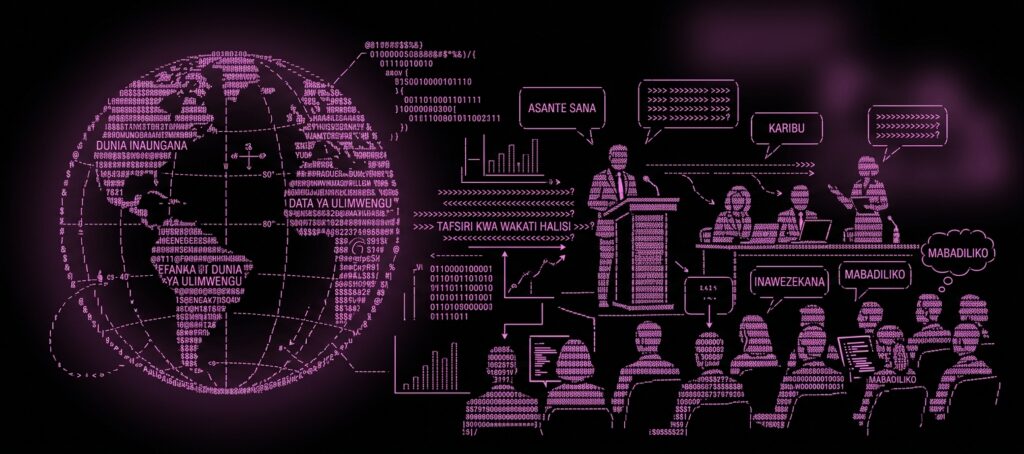
The African Union made history in February 2022 when it adopted Swahili as its sixth official working language, the first language of African origin to earn that status. Three years later, UNESCO followed suit, recognizing Kiswahili as an official language of its General Conference in November 2025. These were not symbolic gestures. With an estimated 200 million speakers across East and Central Africa (Ethnologue, 2024) and a conference circuit stretching from Nairobi’s Kenyatta International Convention Centre to the Kigali Convention Centre’s iconic dome, Swahili event translation has shifted from a regional convenience to a continental necessity.
Kenya’s business events sector generated KES 120 billion in 2024, with the MICE segment accounting for 27% of the country’s 2.4 million tourist arrivals (Kenya Tourism Board, 2024). Rwanda’s Kigali was ranked the second most popular MICE destination in Africa by ICCA. Tanzania’s Julius Nyerere International Convention Centre in Dar es Salaam hosted the Fintech Festival Tanzania in 2025, drawing mobile money innovators from across the M-Pesa ecosystem. Across East Africa, the conference circuit is growing at over 10% annually, and Swahili is the language that ties it all together.
East Africa’s Conference Landscape: Where Swahili Drives the Agenda
Swahili is not confined to one country. It is the official or national language of Tanzania, Kenya, Uganda, Rwanda, and the Democratic Republic of Congo, and a recognized language of the East African Community and the African Union. This geographic spread means that a single event in Nairobi may draw delegates from seven or eight Swahili-speaking nations, each with its own dialect inflections but bound by a shared lingua franca.
The Nairobi Hub
Nairobi dominates East Africa’s conference circuit, handling roughly 80% of the region’s business events. The Kenyatta International Convention Centre (KICC), purpose-built in 1973, remains the anchor venue, hosting over 300 events annually and contributing an estimated 25% to Kenya’s tourism GDP (Kenya Tourism Board). But the city’s capacity is about to expand dramatically: the Bomas International Convention Complex, projected to open for events in May 2026, will accommodate over 10,000 delegates at a time, positioning Nairobi to rival Johannesburg and Cape Town for continental conference supremacy.
Major Nairobi conferences where Swahili-English interpretation is essential include:
- Africa Climate Summit, a biennial AU-convened summit that drew heads of state from across the continent to Nairobi in 2023 and continues as a flagship event for climate finance and adaptation policy
- Africa MICE Summit 2025, a three-day event at KICC (September 9-11, 2025) themed “Catalyzing Trade and Investment Through Business Events,” bringing together global MICE industry leaders
- AfricArena Nairobi Summit, an annual two-day event connecting Africa-focused investors with 20+ startups from seed to growth stage, focusing on climate tech and innovation
- Africa Tech Summit Nairobi, scheduled for February 11-12, 2026, convening corporate leaders, fintech executives, regulators, and investors
- AFSC Summit East Africa 2026, the third edition (June 3-4, 2026), bringing 200+ C-level executives to discuss M-Pesa ecosystem security, EAC regulatory harmonization, and mobile money fraud prevention
Kigali: The Emerging MICE Powerhouse
The Kigali Convention Centre, opened in 2016, can host 5,000 delegates beneath its distinctive dome, a design inspired by the traditional Rwandan royal hut. Kigali has climbed to second place among African MICE destinations in ICCA rankings, driven by deliberate government investment through the Rwanda Convention Bureau.
The Transform Africa Summit, organized by Smart Africa, has made Kigali its home, convening tech leaders and policymakers from across the continent to discuss digital transformation. Rwanda’s hosting of the CHOGM (Commonwealth Heads of Government Meeting) in 2022 cemented the city’s credentials for high-security, heads-of-state-level events where multilingual support is non-negotiable.
Dar es Salaam and Arusha
Tanzania offers two distinct conference venues. The Julius Nyerere International Convention Centre (JNICC) in Dar es Salaam features 12 conference rooms and can seat 1,783 in theater configuration. The Arusha International Conference Centre (AICC), which manages JNICC, has a longer diplomatic pedigree, having hosted negotiations for the Arusha Accords and numerous East African Community summits.
The Fintech Festival Tanzania 2025 at JNICC and the Fintech Society of Tanzania Annual Conference 2026 both spotlight Dar es Salaam’s growing role in fintech events, a natural fit given that Tanzania is the birthplace of M-Pesa’s East African expansion.
Industries Driving Swahili Event Demand
Fintech and Mobile Money
East Africa is the global epicenter of mobile money. M-Pesa, launched in Kenya in 2007, now processes billions of dollars annually across Kenya, Tanzania, the DRC, and Mozambique. The conferences, summits, and regulatory forums that govern this ecosystem operate at the intersection of English, Swahili, and local languages. Events like Seamless East Africa 2026 and the AFSC Summit specifically address M-Pesa ecosystem vulnerabilities and EAC regulatory harmonization, topics where precise Swahili-English translation of financial and regulatory terminology is critical.
Tourism and Wildlife Conservation
East Africa’s tourism economy depends on international visitors, but its workforce, from safari guides to lodge operators and conservation researchers, operates predominantly in Swahili. Conservation conferences, wildlife management summits, and sustainable tourism forums require interpretation that handles both the English of international donors and the Swahili of field practitioners. Conservation vocabulary in Swahili includes specialized terms: hifadhi ya mazingira (environmental conservation), wanyamapori (wildlife), mfumo wa ikolojia (ecosystem).
Renewable Energy and Climate
The Africa Climate Summit series, convened by the African Union, addresses the continent’s energy transition, a conversation that runs through Swahili-speaking nations from Kenya’s geothermal fields to Tanzania’s natural gas reserves and Rwanda’s methane-to-power projects on Lake Kivu. The ESG and Climate Africa Summit (November 2025, Nairobi) represents the growing intersection of climate finance and East African energy policy, where Swahili-speaking policymakers engage with international investors.
Agriculture and Agribusiness
Agriculture employs over 60% of the population in most Swahili-speaking nations. Regional agribusiness conferences, covering everything from smallholder productivity to commodity trading, draw participants who may present in English for international audiences but discuss, negotiate, and network in Swahili. Agricultural technical vocabulary in Swahili is well-developed: kilimo (agriculture), mazao (crops), mifugo (livestock), utafiti wa kilimo (agricultural research).
The Linguistic Challenge: Why Swahili Is Not a Simple Translation Target
Agglutinative Morphology
Swahili is a Bantu language with an agglutinative structure, meaning that single words can carry the semantic load of entire English phrases. The verb nitakupenda encodes subject (ni- “I”), tense (-ta- “will”), object (-ku- “you”), and root (-penda “love”) in one word. For real-time translation and captioning systems, this creates a fundamental mismatch: a three-word English sentence may correspond to a single Swahili word, or vice versa.
The Noun Class System
Swahili organizes nouns into approximately 18 noun classes, each with its own prefix that triggers agreement across adjectives, verbs, pronouns, and demonstratives. Class 1/2 (wa-/m-) covers people, class 7/8 (ki-/vi-) covers tools and diminutives, class 9/10 (n-/n-) covers animals and loanwords. A translation system that does not understand noun class agreement will produce grammatically broken output that Swahili speakers immediately recognize as machine-generated.
Consider a conference presentation about technology tools: kifaa (tool, class 7) requires different agreement markers than programu (program, class 9) or mtaalamu (expert, class 1). Getting these agreements wrong is the Swahili equivalent of mixing up “he” and “she” in every sentence: technically intelligible but jarring and unprofessional.
Loanword Complexity
Swahili’s role as a trade lingua franca for centuries has resulted in an unusually large inventory of loanwords from Arabic, Persian, Portuguese, Hindi, and English. Many technical and business terms come directly from English (kompyuta, benki, teknolojia), but others are Arabic-origin (hesabu for mathematics, biashara for business). Financial terminology at a fintech conference might draw from three source languages within a single sentence.
Code-Switching: The Sheng Factor
In Nairobi’s professional circles, speakers routinely code-switch between Swahili and English, sometimes within a single sentence. This phenomenon is even more pronounced in Sheng, a Swahili-English-local language hybrid spoken widely by younger Kenyans. At tech conferences and startup events, speakers may begin a sentence in English, switch to Swahili for emphasis, and weave in Sheng slang. Real-time interpretation must handle these mid-sentence language switches without breaking down, a challenge that stumps most conventional interpretation setups.
A Scenario: The East African Energy Transition Forum
Picture a three-day energy transition forum at KICC Nairobi. You have 800 delegates: government ministers from Kenya, Tanzania, Uganda, and Rwanda; representatives from international development agencies (USAID, DFID, GIZ); European renewable energy developers; and local project implementers from rural geothermal and solar installations.
Your keynote speaker, a Tanzanian energy minister, presents in Swahili, formal, policy-grade Kiswahili with specialized energy terminology. The panel that follows includes a German wind energy executive speaking English, a Kenyan regulator who code-switches between Swahili and English, and a Rwandan representative who moves between Swahili and French. Your breakout sessions run in parallel across six rooms, covering technical, regulatory, and community engagement tracks.
Traditional interpretation would require 8-12 interpreters covering Swahili-English and French-English pairs, at a cost exceeding $30,000 for the event. Finding interpreters with energy-sector expertise in Swahili, who understand terms like nishati mbadala (renewable energy), jotoardhi (geothermal), and gridi ya umeme (electrical grid), narrows the available pool dramatically.
This is exactly the scenario Snapsight was built for. Rather than staffing a dozen specialized interpreters, Snapsight’s real-time transcription captures every session in its source language and delivers live translation to each attendee’s device. The Tanzanian minister’s energy policy address is transcribed in Swahili and simultaneously available in English and French. After the event, AI-generated summaries synthesize insights across all 18 breakout sessions, regardless of the source language, producing cross-session intelligence that would take a human team days to compile.
With 627 events powered and 10,415 sessions transcribed across 75+ languages, Snapsight’s AI handles the agglutinative morphology, noun class agreements, and code-switching patterns that make Swahili a challenge for general-purpose translation tools. The system operates at 91% autonomy, meaning minimal human intervention is required during the event itself.
Cultural Context for Event Organizers
Harambee and Collective Participation
The Swahili concept of harambee, roughly translated as “pulling together,” shapes how East African events operate. Audience participation is expected, not optional. Q&A sessions tend to run longer than at Western conferences, with attendees offering extended commentary rather than concise questions. Town-hall formats and community consultation sessions are common, especially at government and development events. Your translation setup must accommodate this participatory culture, not just handle one-way presentation translation.
Religious and Calendar Considerations
East Africa’s Swahili-speaking coast has a significant Muslim population, particularly in Tanzania’s Zanzibar, Kenya’s Mombasa, and along the Indian Ocean littoral. Event scheduling must account for Ramadan, Friday prayers, and Islamic holidays. Inland cities like Nairobi and Kigali are predominantly Christian, with Sunday considerations. Conference catering, timing of sessions, and even the formality of opening remarks vary significantly between coastal and inland events.
The Ubuntu Dimension
Ubuntu philosophy, utu in Swahili, emphasizes collective dignity and communal respect. At East African conferences, this manifests as a preference for consensus-building over adversarial debate, extended greeting protocols (especially for senior attendees and government officials), and networking formats that prioritize relationship-building over transactional card-swapping. Event organizers unfamiliar with these norms risk creating formats that feel culturally alien to Swahili-speaking attendees.
Beyond Translation: Swahili Event Intelligence
Translation gets attendees through the language barrier. Snapsight goes further.
AI-Generated Summaries in Swahili
Every session is summarized in Swahili, capturing the key arguments, data points, and action items. For delegates who could not attend parallel sessions, these summaries provide full coverage without the delay of manual translation.
Cross-Session Synthesis
At a multi-track conference like the Africa Climate Summit, themes emerge across sessions that no single attendee can track. Snapsight’s cross-session intelligence identifies connections, between a morning panel on climate finance and an afternoon technical session on geothermal development, for example, and presents them in the attendee’s preferred language.
Post-Event Content in Swahili: For organizations targeting Swahili-speaking audiences after the event, Snapsight produces transcripts, summaries, and key takeaways in Swahili, content that can feed newsletters, reports, and social media without requiring separate translation vendors.
Frequently Asked Questions
Swahili has approximately 16 million native speakers and between 150-200 million total speakers including second-language users (Ethnologue, 2024). It is an official language of Tanzania, Kenya, Uganda, Rwanda, and the Democratic Republic of Congo, a lingua franca across much of East and Central Africa, an official working language of the African Union, and as of November 2025, an official language of UNESCO’s General Conference. The East African Community also adopted Kiswahili as an official language alongside English and French.
Swahili’s agglutinative morphology, where a single word can encode subject, tense, object, and verb root, presents challenges for AI systems trained primarily on English. Snapsight’s models are trained on event-specific Swahili content, including formal policy language, technical terminology, and the Swahili-English code-switching common at East African conferences. The noun class agreement system (18 classes) is handled through context-aware processing that maintains grammatical coherence across translated output.
Traditional simultaneous interpretation for a three-day conference with Swahili-English and Swahili-French pairs typically costs $25,000-$40,000, depending on the number of parallel sessions and the technical specialization required. Swahili interpreters with expertise in fields like energy, fintech, or conservation are in limited supply, and sourcing them can add weeks to your planning timeline. AI-powered solutions like Snapsight can reduce these costs significantly while scaling across more sessions and language pairs simultaneously.
Standard Swahili (based on the Zanzibar dialect, Kiunguja) is widely understood across all Swahili-speaking countries and is the form used in formal settings, media, and education. However, attendees from coastal Tanzania may use more Arabic-influenced vocabulary, while Congolese speakers may use terms influenced by French and other Bantu languages. For most conference settings, Standard Swahili serves all audiences well. Snapsight’s AI is trained on Standard Swahili while recognizing common regional variations.
Swahili uses the standard Latin alphabet with no special diacritics or modified characters in its modern written form, making it straightforward for display on any device or captioning system. Historically, Swahili was written in a modified Arabic script (Ajami), but Latin script has been standard since the colonial period and is used universally in professional and government contexts today.