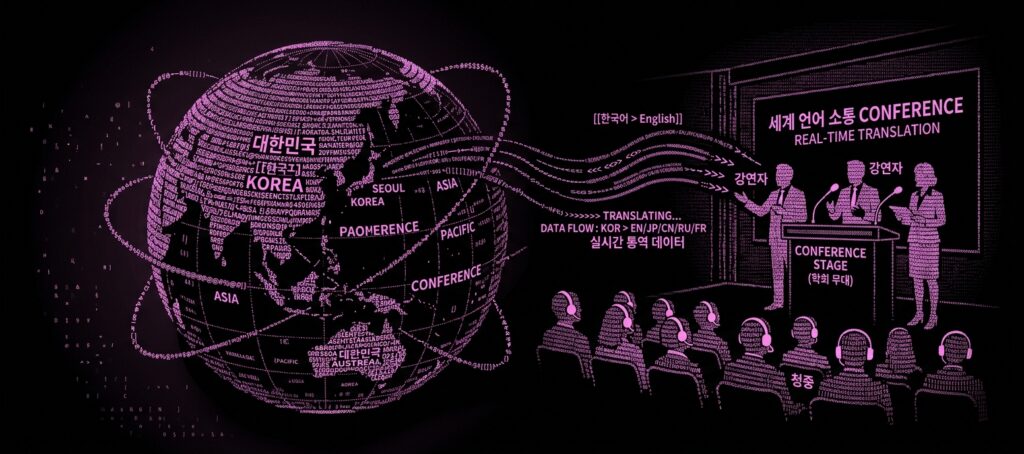
South Korea hosted 243 international association meetings in 2024, ranking third in Asia-Pacific behind Japan and China (ICCA, 2024 Country Rankings). Seoul climbed three places in the global city rankings to second in the region, behind only Singapore. But here is the detail that matters most for event organizers: when you filter for gatherings exceeding 1,000 delegates, Korea jumps to fourth globally, a country of 52 million people outperforming nations five and ten times its size at hosting large-scale international events.
Korean event translation is not a niche concern. It is central to one of the most well-funded, government-backed MICE ecosystems in the world, and one of the most linguistically demanding for anyone who does not understand why a single Korean verb ending can change the meaning of an entire sentence.
Why Korea’s Event Market Demands Specialized Translation
The Scale of Korea’s MICE Ambition
The Korean government treats its MICE industry as strategic infrastructure. The Korea Tourism Organization operates a dedicated Korea MICE Bureau (established in 1979) with regional convention bureaus in Seoul, Busan, Daegu, Daejeon, and Jeju. International MICE participants spend an average of 2.8 million won (approximately $2,100 USD) per person, and the sector accounts for roughly 9.2% of Korea’s total tourism revenue, with international conferences making up 68.5% of that figure (Korea Tourism Organization, 2024).
Market context: The Asia-Pacific MICE market overall is valued at $469.7 billion in 2025 and is projected to reach $925.86 billion by 2035 (Precedence Research, 2025). Korea has invested billions in convention infrastructure: COEX in Seoul, BEXCO in Busan, Songdo ConvensiA in Incheon, EXCO in Daegu, and ICC Jeju.
Major Conferences Driving Translation Demand
Korea’s conference calendar spans virtually every industry vertical:
G-STAR (Global Game Exhibition) at BEXCO in Busan draws over 650 gaming companies from more than 30 countries across 3,000+ exhibition booths, requiring Korean-English-Japanese-Chinese interpretation across keynotes, developer panels, and B2B matchmaking sessions.
InterBattery at COEX, Seoul, attracts manufacturers, researchers, and end users from around the world. SK On, Samsung SDI, and LG Energy Solution present in Korean to international buyer delegations, all requiring real-time technical translation of specialized electrochemistry vocabulary.
KIMES (Korea International Medical and Hospital Equipment Show) occupies the entire COEX Exhibition Hall each March, drawing healthcare procurement teams from across Southeast Asia, the Middle East, and Europe.
World Knowledge Forum hosted by Maeil Business Newspaper convenes global thought leaders, economists, and policymakers, presenting in English to predominantly Korean-speaking audiences who expect precise, nuanced interpretation.
The Korean Language: Why Generic Translation Fails at Events
Honorific Speech Levels Change Everything
Korean has one of the world’s most elaborate honorific systems. Unlike Japanese, where honorifics are largely additive, Korean embeds social hierarchy directly into verb conjugation, noun selection, and sentence structure. There are seven distinct speech levels, and choosing the wrong one does not just sound awkward, it signals disrespect.
At conferences, when a junior researcher presents findings to a panel that includes a government minister and a university president, the Korean speaker will shift speech levels mid-sentence based on who they are addressing. An interpreter must track these shifts in real-time and render them in English in a way that preserves the relational dynamics.
Agglutinative Grammar and Word Order
Korean is agglutinative, meaning grammatical information (tense, aspect, mood, politeness, negation) is expressed through chains of suffixes attached to verb and noun stems. A single Korean verb form can contain information that requires an entire English clause to express.
The structural timing problem: Korean is an SOV (subject-object-verb) language, meaning the verb, which carries the sentence’s core meaning and emotional register, arrives at the end. An interpreter working Korean-to-English must wait for the verb before constructing an English sentence. In fast-paced conference settings, this lag compounds across sentences.
Hangul Script and Technical Vocabulary
Much of Korean technical and scientific vocabulary is borrowed from English, transliterated into Hangul, but then morphologically integrated into Korean grammar with native suffixes. A Korean biotech CEO discussing mRNA vaccine delivery mechanisms will produce sentences that alternate between transliterated English technical terms and native Korean grammatical structures, sometimes within a single clause.
Seoul, Busan, and Incheon: Korea’s Event Hub Triangle
Seoul
COEX offers 36,007 sqm of exhibition space, a 7,000-seat auditorium, and 61 meeting rooms. Ranked second in Asia-Pacific for international association meetings in 2024. Convention bureau actively subsidizes interpretation services.
Busan
BEXCO offers 46,500+ sqm of exhibition space and 53 meeting rooms. Strong Korean-Japanese bilingual capacity due to proximity to Japan. Home to G-STAR and growing creative industry hub.
Incheon: The Gateway Play
Songdo ConvensiA, located 20 minutes from Incheon International Airport, features exhibition space for 900 booths and 20,000 attendees, two ballrooms accommodating 3,000 people, and 35 meeting rooms. Default venue for events with high international attendance ratios.
Korean Business Culture at Events
Korean business culture is deeply hierarchical, and this extends to every aspect of event logistics. Understanding kibun (maintaining dignity and harmony) is essential for interpretation. An interpreter who renders a senior executive’s statement with insufficient formality disrupts the relational fabric of the event.
The concept of hoesik, post-event group dining, is a cornerstone of Korean professional relationship building. Smart organizers incorporate hoesik-style dinners into the official program, with interpretation support extending through the evening.
Koreans regard punctuality as a fundamental sign of professional respect. Sessions that start late create negative impressions that compound across a multi-day event.
A Scenario: What Korean Event Translation Actually Looks Like
Consider a three-day pharmaceutical conference at COEX, Seoul. Twelve hundred attendees: 60% Korean-speaking, 30% English-speaking, 10% Japanese-speaking. Twenty-four breakout sessions run in parallel across eight rooms over three days.
Traditional remote simultaneous interpretation for this event requires 12 to 16 interpreters across three language pairs, at a cost exceeding $45,000. Staffing Korean-Japanese medical interpreters in Seoul requires months of lead time, as there are fewer than 200 certified Korean-Japanese medical interpreters in all of Korea.
This is the scenario Snapsight was built for. Rather than staffing 16 interpreters, Snapsight’s real-time transcription captures every session in its source language, then delivers live translation to each attendee’s device. After each day, Snapsight’s Analyst Agent synthesizes insights across all 24 breakout sessions, regardless of source language.
Across 627 events and 10,415 sessions processed, Snapsight operates at 91% autonomy, meaning the technology team does not need to monitor every room. For a 24-session-per-day conference, this is the difference between feasible and impossible.
The Korean Language Pairs That Matter
- Korean-English: the baseline for virtually every international event in Korea. Year-round demand across every industry.
- Korean-Japanese: critical for gaming, automotive, electronics, and maritime events. Qualified interpreters are scarce outside Seoul and Busan.
- Korean-Chinese (Mandarin): driven by trade relationships and manufacturing supply chains. Requires navigating cultural and political sensitivities.
- Korean-Southeast Asian languages: growing demand driven by Korean cultural exports (K-pop, K-drama, K-beauty) across Vietnam, Thailand, Indonesia, and the Philippines.
Snapsight supports all of these pairs across its 75+ language portfolio, eliminating the staffing bottleneck that makes multi-language Korean events prohibitively expensive through traditional interpretation.
Frequently Asked Questions
Traditional Korean-English simultaneous interpretation typically costs $1,500 to $2,500 per interpreter per day, and industry best practice requires two interpreters per language pair per room. For a three-day conference with eight parallel rooms and two language pairs, you are looking at $48,000 to $80,000 in interpretation costs alone, before equipment, booth rental, and technical support. AI-powered solutions like Snapsight reduce this cost by 60-80% while supporting more language pairs simultaneously.
Modern AI transcription systems have made significant progress on Korean honorifics, but accuracy varies by system and domain. Snapsight’s Korean transcription preserves speech level markers in the source transcript. For live translation to English, the system renders content in appropriate English register rather than attempting literal honorific translation, the same approach professional human interpreters use.
Yes. Korean-Japanese and Korean-Chinese are distinct language pairs that require separate interpretation resources. With traditional interpretation, this means staffing two additional interpreter teams. With Snapsight, both language pairs are handled simultaneously through the same platform, with each attendee receiving content in their preferred language on their own device.
Seoul (COEX, DDP) is the clear leader with the deepest infrastructure and interpretation talent pool. Busan (BEXCO) excels for events in gaming, film, and maritime industries, with strong Korean-Japanese bilingual capacity. Incheon (Songdo ConvensiA) is ideal for events with high international attendance ratios due to its proximity to the airport. All three cities have active convention bureaus that provide logistical and financial support for international events.