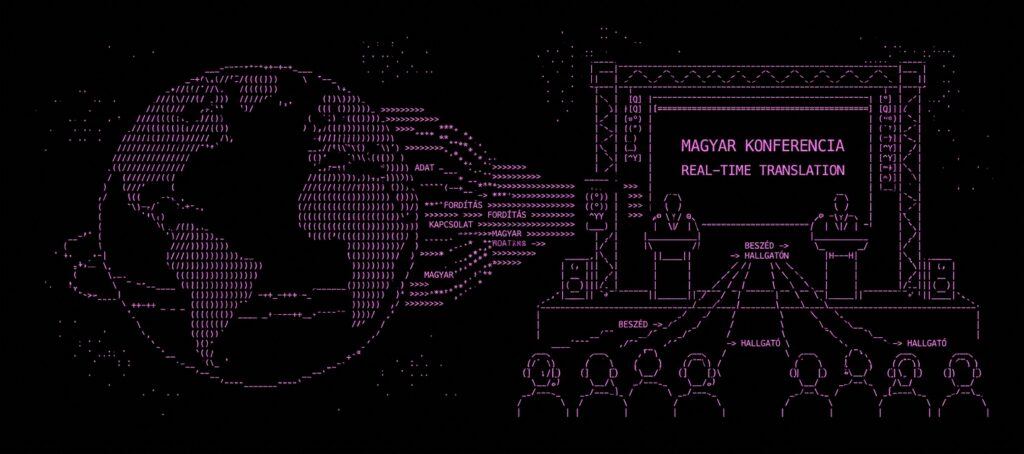
Hungary hosted the 11th World Science Forum in Budapest in November 2024, drawing 500 ministerial-level delegates and scientists from dozens of countries for four days of sessions on global science policy (UNESCO, 2024). That same month, the AUTOMOTIVE HUNGARY exhibition brought more than 400 exhibitors from 15 countries and over 15,000 trade professionals to HUNGEXPO (HUNGEXPO, 2024). In both cases, the translation challenge was the same: Hungarian has no close linguistic relatives in the European Union, making it one of the hardest languages on the continent to interpret in real time.
Hungarian event translation is not a problem you solve with general-purpose tools or interpreters who “also do Hungarian.” With approximately 13 million native speakers worldwide (Ethnologue, 2024), Hungarian is an agglutinative Uralic language surrounded on all sides by Indo-European neighbors, a linguistic island in the heart of Central Europe. Its 18 grammatical cases, vowel harmony system, and unique definite-indefinite verb conjugation mean that simultaneous interpretation requires specialists who have spent years mastering the language’s internal logic.
Budapest: Central Europe’s Enduring Conference Capital
Budapest has been a fixture on the international conference circuit for decades. The city consistently ranks among Europe’s top 20 MICE destinations by the ICCA, and its combination of world-class venues, competitive pricing, and central European geography makes it a natural choice for pan-European and global events.
Venues That Define the Hungarian Event Market
HUNGEXPO Budapest Congress and Exhibition Centre is Hungary’s largest event venue, offering 75,000 square meters of event space across its exhibition halls and a dedicated Congress Centre with 15,000 square meters on three levels. The plenary hall seats 2,000, with 29 additional meeting rooms for breakout sessions. HUNGEXPO can accommodate up to 15,000 attendees and sits just 15 minutes from Budapest’s city center (HUNGEXPO, 2025).
Budapest Congress Center (Budapest Kongresszusi Kozpont) is the city’s purpose-built congress facility in the Buda hills, with a 1,700-seat main auditorium and 22 meeting rooms. Papp Laszlo Budapest Sportarena handles large-scale events with capacity for over 12,000 attendees.
The Conferences Driving Hungarian Translation Demand
| Conference | Location | Size | Industry |
|---|---|---|---|
| World Science Forum | HUNGEXPO / various | 500+ delegates | Science policy, research |
| AUTOMOTIVE HUNGARY | HUNGEXPO | 15,000+ | Automotive, manufacturing |
| Budapest Water Summit / IAH 2026 | Various | 200-1,000+ | Water management, environment |
| PHARM Connect Congress | HUNGEXPO | 500+ | Pharmaceutical, life sciences |
| SMART CITIES Budapest | Various | 300+ | Urban tech, governance |
The water sector deserves special mention. Budapest has emerged as an unlikely global hub for water-related diplomacy and science. The 53rd World Groundwater Congress of the International Association of Hydrogeologists (IAH 2026) runs September 14-18, 2026 in Budapest (IAH, 2026).
Hungary’s Industry Landscape: Why These Conferences Need Translation
Automotive Manufacturing
Hungary’s automotive sector is the engine of its economy. The country produces more than 800,000 vehicles annually through four major assembly plants: Audi in Gyor, Mercedes-Benz in Kecskemet (soon to be Mercedes’ largest production base outside China), Suzuki in Esztergom, and BMW’s new electric vehicle factory in Debrecen, which began production in late 2025 (Trade.gov, 2025). The automotive sector employs around 100,000 people and generates approximately 20% of Hungary’s GDP.
Pharmaceuticals and Life Sciences
Eight of the global top ten pharma and biotech companies have manufacturing or R&D operations in Hungary. Domestic giants like Gedeon Richter (specializing in biosimilars and specialty pharma) and Egis Pharmaceuticals anchor a sector that punches well above Hungary’s population weight.
The Hungarian Language: Why It Breaks Most Translation Systems
Hungarian is routinely cited among the hardest languages for English speakers to learn, and for good reason. But the challenges that matter for event translation are specific and worth understanding in detail.
Agglutination: One Word Does the Work of an English Phrase
Hungarian is an agglutinative language, meaning it builds meaning by stacking suffixes onto root words. Where English uses prepositions and separate words, Hungarian collapses them into a single, often very long, word. For real-time interpretation, this creates a fundamental timing problem. A Hungarian speaker can deliver a concept in one or two words that requires five or six in English, or vice versa.
18 Grammatical Cases
18 cases in action: Hungarian nouns decline through 18 case suffixes (some linguists count as many as 35). “Haz” (house) becomes “hazban” (in the house), “hazbol” (from the house), “hazhoz” (to the house), “hazon” (on the house), “hazra” (onto the house), “hazrol” (from on the house), and so on through locative, instrumental, causal, and translative cases. For event transcription, every suffix must be correctly identified in real time. A single misheard suffix changes the meaning of the entire sentence.
Vowel Harmony
All suffixes in Hungarian must harmonize with the vowels in the root word. Back vowels (a, o, u) take back-vowel suffixes; front vowels (e, i, o, u) take front-vowel suffixes. This is systematic and predictable for native speakers, but it adds a layer of complexity that AI systems must model explicitly.
Definite vs. Indefinite Conjugation
Hungarian verbs conjugate differently depending on whether the object is definite or indefinite, a distinction that does not exist in English, German, or most other European languages. “Latok egy hazat” (I see a house, indefinite) uses a different verb form than “Latom a hazat” (I see the house, definite). This affects every transitive verb in the language.
No Indo-European Relatives
Hungarian belongs to the Uralic language family, with its closest relatives being Finnish and Estonian, and even those are distant cousins. For practical purposes, Hungarian has no mutually intelligible relatives anywhere. An interpreter who speaks German, Czech, Slovak, and Romanian, all of Hungary’s neighbors, has zero transferable knowledge when it comes to Hungarian. This is why Hungarian interpretation consistently commands premium rates.
A Scenario: The International Automotive Conference in Budapest
Imagine you are organizing a three-day automotive innovation summit at HUNGEXPO. Your attendee list includes 800 professionals: 50% Hungarian-speaking engineers and executives from domestic suppliers and the Audi/Mercedes/BMW plants, 30% German-speaking participants from parent companies and Tier 1 suppliers, and 20% English-speaking attendees from Asian battery manufacturers, American EV startups, and international standards bodies.
The traditional interpretation approach requires six interpreters covering three language pairs (Hungarian-English, Hungarian-German, German-English), at an estimated cost of EUR 25,000-35,000 for the event. Staffing Hungarian-German automotive interpreters alone will take weeks of lead time, because the pool of interpreters who can handle both Hungarian agglutinative technical vocabulary and German automotive engineering terminology is vanishingly small.
The Snapsight solution: Rather than staffing six interpreters across three language pairs, Snapsight’s AI-powered real-time transcription captures each session in its source language and delivers live translation to every attendee’s device. The Hungarian CEO’s keynote, laden with technical compound words, is transcribed in Hungarian and simultaneously available in English and German. After the event, AI-generated summaries synthesize insights across all sessions regardless of source language. With 627 events and 10,415 sessions processed, Snapsight handles Hungarian’s agglutinative complexity through models specifically trained on event contexts, operating at 91% autonomy.
Cultural Considerations for Events in Hungary
Naming Conventions
Hungarian uses the Eastern name order: family name first, given name second. “Kovacs Istvan” is Mr. Kovacs, not Mr. Istvan. This applies to name badges, speaker introductions, and all event materials. Getting it wrong signals unfamiliarity with Hungarian culture.
Event Hospitality
Hungarian event culture places high value on hospitality. Conference dinners are expected, not optional. Tokaji wine (from one of the world’s oldest classified wine regions) and palinka (fruit brandy) are traditional offerings. Thermal bath culture sometimes extends into networking, as Budapest’s Szechenyi and Gellert baths have hosted corporate events.
Hungarian events frequently involve neighboring languages. For organizers managing multilingual conferences that span the V4 region or broader Central Europe, our guides to Czech event translation and German event translation cover the linguistic and logistical challenges specific to those languages.
Frequently Asked Questions
Traditional Hungarian-English simultaneous interpretation typically runs EUR 800-1,200 per interpreter per day, and most events require at least two interpreters per language pair to manage fatigue. For a three-day, three-language conference (Hungarian, English, German), expect EUR 25,000-40,000 in interpretation costs alone, plus equipment rental. Hungarian-German interpreters command premium rates due to the small specialist pool. AI-powered alternatives like Snapsight can reduce these costs significantly while covering unlimited language pairs simultaneously.
Modern AI transcription systems have made significant progress with agglutinative languages, but quality varies widely between providers. The core challenge is that Hungarian builds meaning through suffix chains that can produce words with no direct equivalent in the target language. Snapsight’s models are trained on event-specific Hungarian content, including the technical vocabulary common in automotive, pharmaceutical, and scientific conferences, the sectors that dominate Budapest’s event calendar.
For international events in Budapest, bilingual Hungarian-English materials are standard practice. However, Hungarian text is typically 15-25% longer than English for the same content, due to the language’s suffix-heavy structure. This affects signage, slide design, printed programs, and digital interfaces. Real-time captioning must also account for this expansion factor, as Hungarian captions need more screen space than their English equivalents.
Hungarian-English is the dominant pair at virtually every international event in Budapest. Hungarian-German is the second most common, reflecting Germany’s role as Hungary’s largest trading partner and the presence of major German automotive manufacturers. Hungarian-French appears at EU-related events, and Hungarian-Russian remains relevant for conferences involving CIS-region participants, particularly in energy and water sectors.
Budapest is an excellent choice. HUNGEXPO alone offers 75,000 square meters of event space with a 2,000-seat plenary hall, and the city’s venue network can handle everything from intimate 50-person board meetings to 15,000-attendee exhibitions. Costs are 30-40% lower than Vienna or Munich for comparable facilities. The challenge is specifically the Hungarian language component, which is why AI-powered translation solutions are increasingly popular at Budapest events, eliminating the bottleneck of sourcing specialist Hungarian interpreters.