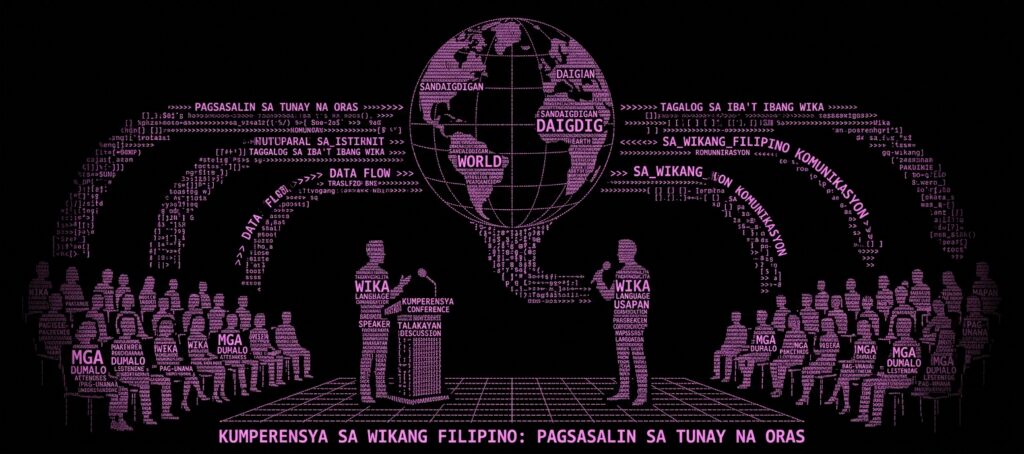
The SMX Convention Center network recorded 8.54 million visitors in 2025, a 34% surge over the previous year, and hosted 1,632 events across its eight Philippine properties (ABS-CBN News, March 2026). The Philippines is preparing to host both the 48th and 49th ASEAN Summits in 2026 at a newly renovated Philippine International Convention Center. And somewhere in a breakout room at a BPO industry conference in Makati, a panelist just switched from English to Tagalog mid-sentence for the fourth time in two minutes, and neither the captioning system nor the interpreter booth caught the transition cleanly.
Filipino event translation sits at the intersection of a surging MICE market, the world’s fourth-largest remittance economy ($39.62 billion in personal remittances in 2025, per the Bangko Sentral ng Pilipinas), and a linguistic reality that defies conventional translation workflows. The Philippines has 183 living languages (Ethnologue, 2025), two official languages, and a default mode of professional communication, Taglish, that blends Filipino and English within single sentences. For event organizers, that combination creates both massive opportunity and a translation challenge unlike any other market in Asia.
The Philippines as a MICE Destination: From Emerging to Essential
The Philippines ranked 49th worldwide and 13th in Asia-Pacific for international association meetings in the most recent ICCA rankings, a position that understates the country’s trajectory. The Tourism Promotions Board’s “We Take Your Business To Heart” campaign, featured in a Bloomberg-sponsored initiative, explicitly targets MICE as a growth sector (Bloomberg Sponsored Content, 2025). In February 2026, the Philippines launched a specialized seven-city MICE guidebook covering Manila, Clark, Boracay, Iloilo, Cebu, Bohol, and Davao to showcase readiness for international business events (TTGmice, February 2026).
Flagship Venues
Philippine International Convention Center (PICC), the country’s original convention venue, opened in 1976, underwent a comprehensive renovation from March to September 2025 ahead of its 50th anniversary and the twin ASEAN Summits in 2026. Its Plenary Hall seats 3,500+, making it the default venue for government summits and large-scale international conferences.
SMX Convention Center Manila has won the World MICE Awards for Philippines’ Best Convention Center in 2022, 2023, and 2024, three consecutive years recognizing it as the country’s premier privately-owned convention facility. SM Prime Holdings is building the 18,000-square-meter SMX Center for International Trade and Exhibitions in Pasay City, set to open in early 2027 as the country’s largest exhibition venue (Tribune, March 2026).
World Trade Center Metro Manila projects robust demand through 2026 and is betting on the Philippines’ MICE growth trajectory (MEXC News, 2026).
Marquee Events That Drive Translation Demand
- ASEAN Summits 2026: The Philippines is hosting both the 48th and 49th ASEAN Summits at PICC, bringing together heads of state and thousands of delegates from across Southeast Asia. Multilingual support spanning Filipino, English, Thai, Vietnamese, Indonesian, and Malay is non-negotiable.
- ASEAN Tourism Forum and Travex 2026: Held in Mactan, Cebu from January 27 to February 4, 2026, this event brought over 700 international buyers and sellers together with ASEAN tourism ministers (Philippine Information Agency, 2026).
- Shared Services and BPO Week Philippines 2026: Now in its 16th year, this is the Philippines’ flagship event for the global business services sector. The Philippine BPO industry closed 2024 at $38 billion in export revenues with 1.82 million full-time professionals (IBPAP, 2024), projected to exceed $40 billion in 2025.
- Franchise Asia Philippines 2026: The biggest and longest-running franchise expo in Asia. April 23-26 at SMX Convention Center Manila, with international exhibitors and Filipino franchisors creating a consistently bilingual environment.
- DEVCON Philippines Summit: The country’s largest volunteer-run developer community, hosting sessions spanning AI, open source, web3, and software development. Technical content in English; audience engagement shifts to Taglish.
- EITI Global Conference 2026: The Philippines will be the first EITI-implementing country in Asia to host the 10th Extractive Industries Transparency Initiative Global Conference in June 2026 (PH-EITI, 2026).
The Filipino Language: Why This Is Not a Standard Translation Job
Taglish Is the Norm, Not the Exception
The defining characteristic of Filipino event translation is Taglish, the fluid code-switching between Tagalog and English that constitutes the default communication mode for educated, urban Filipinos. This is not broken language or a sign of limited fluency. Linguistic research published in the Asia Pacific Education Review documented that Taglish serves deliberate communicative functions including “efficiency, message qualification, linguistic play, emphasis, objectivization, and personalization” (Bautista, 2004).
The Taglish translation problem: A system configured for “Filipino to English” interpretation encounters sentences already 40-60% in English. A captioning system trained on pure Tagalog stumbles over English insertions. A pure English transcription drops the Filipino connective tissue that carries the sentence’s meaning and emotional register.
A BPO operations director at an industry conference might say: “Kailangan natin i-optimize yung workflow para ma-reduce yung attrition rate natin.” That sentence follows Tagalog grammar while incorporating English technical vocabulary, and represents normal professional Filipino speech.
VEQTA Translations describes the localization challenge precisely: “When you localize Taglish content into English, you aren’t just translating words; you’re dismantling identity signals, power structures, and cultural rhythms embedded in language choice” (VEQTA, 2025). English signals education and cosmopolitanism; Filipino communicates warmth, sincerity, and solidarity. Most speakers toggle between these registers multiple times per minute at events.
183 Living Languages, Not Just Two
Filipino (standardized from Tagalog) is the national language, but it is the first language of only about 22.5 million of the Philippines’ 115+ million people (Ethnologue, 2025). The country has 183 living indigenous languages, including Cebuano (roughly 20 million speakers), Ilocano, Hiligaynon, Waray, Kapampangan, Bikol, and Pangasinan. At a conference in Cebu, informal interactions and audience questions may shift to Cebuano. A government consultation in Davao encounters Bisaya. A tourism event drawing delegates from across the Visayas and Mindanao will surface multiple regional languages.
This means a conference outside Manila may need three-layer translation support: English for international attendees, Filipino for the national audience, and the regional language for local participants.
Formality Registers Shape Technology Configuration
| Event Type | Dominant Register | Translation Configuration |
|---|---|---|
| Government proceedings, academic conferences | Formal Filipino with minimal English | Filipino-primary ASR models |
| Corporate events, tech conferences | Heavy Taglish | Bilingual code-switching models |
| Startup meetups, developer conferences | Near-English with Filipino for rapport | English-primary with Filipino detection |
The Diaspora Factor: Why Filipino Event Translation Extends Far Beyond Manila
The Philippines’ global diaspora amplifies demand for Filipino event translation well beyond the archipelago. Personal remittances hit $39.62 billion in 2025, a 3.3% increase over 2024’s $38.34 billion (BSP, 2026). The Philippines ranks as the world’s fourth-largest remittance recipient behind India, Mexico, and China (World Bank, 2024).
| Diaspora Location | Filipino Population | Event Translation Context |
|---|---|---|
| United States | 1.7+ million Tagalog speakers | Healthcare conferences, nursing professional events |
| Saudi Arabia | 938,000+ | Filipino community events, business networking |
| Canada | 676,000+ | Immigration and settlement conferences |
| UAE | 541,000+ | Remittance industry summits |
| Japan | 313,000+ | Technical training, cultural exchange events |
Key insight: An estimated 2.19 million Overseas Filipino Workers were deployed in 2024 (Philippine Statistics Authority, 2025). Any event targeting the Filipino diaspora audience needs Filipino or Taglish support to achieve genuine engagement.
A Real Scenario: Navigating a Multi-Track BPO Conference
Consider a two-day BPO industry summit at PICC with 800 attendees. The morning keynote comes from a US-based technology executive speaking English. The subsequent panel features four Filipino BPO leaders who begin in English but shift to Taglish within minutes as they debate workforce strategy. Afternoon breakout sessions split between English-only technical workshops and Taglish-heavy management roundtables. The closing plenary, delivered by a government official from the Department of Trade and Industry, runs in formal Filipino.
Traditional interpretation would require separate interpreter teams for each language direction, with most struggling during the Taglish panels where the source language shifts multiple times per sentence. Post-event, the multinational sponsor needs English transcripts for their global leadership team, but a pure English transcription of the Taglish panels misses nuances embedded in the Filipino portions.
Traditional Interpretation
- Separate interpreter teams per language direction
- Struggles with Taglish mid-sentence switching
- English transcripts miss Filipino nuance
- Cost: $15,000-$25,000
AI-Powered (Snapsight)
- Captures Taglish as spoken
- Real-time translation to each device
- Post-event summaries in any language
- 10,415+ sessions across 627+ events
Manila, Cebu, Clark: Three Hubs, Three Event Cultures
Metro Manila
Metro Manila concentrates the Philippines’ largest and most internationally oriented events. PICC, the World Trade Center, and SMX Convention Center anchor a convention corridor in Pasay. Government summits, international association meetings, and Fortune 500 corporate events default to Manila. The city’s concentration of BPO offices, employing over a million professionals in BGC, Makati, Ortigas, and Alabang, generates constant demand for industry conferences, training events, and executive briefings.
Cebu
Cebu is the Philippines’ fastest-growing MICE destination, having hosted the ASEAN Tourism Forum in January 2026. New venue capacity, including the Mactan Expo and the forthcoming largest SMX Convention Center, positions Cebu for mid-size international events. Cebu’s event culture has a stronger Cebuano language presence than Manila, adding a third language layer to the translation equation.
Clark
Clark Freeport Zone in Pampanga has hosted MICECON (the Philippine MICE Conference) and is building out convention infrastructure. The Philippines’ MICE guidebook positions Clark alongside Manila and Cebu as a primary destination, with modern hotels and the Clark International Convention Center in development.
Practical Guidance for Event Organizers in the Philippines
- Do not assume English-only will suffice. Filipino professionals are highly proficient in English, but genuine engagement (panels, Q&A, networking) happens in Filipino or Taglish.
- Plan for Taglish, not just Filipino. Any translation system treating Filipino and English as separate, discrete languages will produce fragmented output at Philippine events.
- Budget for regional language support outside Manila. A conference in Cebu with local industry participation should plan for Cebuano.
- Respect the Philippine calendar. Holy Week (late March/April) effectively pauses the country. The Christmas season starts in September (“BER months”).
- Embrace Filipino hospitality norms. The concept of pakikisama (smooth interpersonal relations) means Filipino audiences value warmth and relationship-building at events.
- Leverage the timezone advantage. The Philippines (UTC+8) shares a timezone with Singapore, Hong Kong, and mainland China, making Manila and Cebu natural hosts for Asia-Pacific events.
Traditional Filipino-English simultaneous interpretation in Manila runs $1,500-$3,000 per day for a two-interpreter team, plus equipment rental of $2,000-$5,000 depending on venue size and receiver count. A three-day conference with multiple parallel tracks can reach $15,000-$25,000 in total interpretation costs. AI-powered solutions like Snapsight reduce this substantially while adding transcription, translation, and post-event intelligence capabilities that traditional interpreters cannot provide.
This is the critical question for Philippine events. Most translation tools treat Filipino and English as separate languages, which breaks when a speaker switches mid-sentence. Snapsight processes multilingual speech as it actually occurs, capturing Taglish code-switching and delivering coherent translations rather than fragmented output from two competing language models.
Yes. While English proficiency is high, particularly in BPO, technology, and professional services, Filipino or Taglish is the language of authentic engagement. Panels, Q&A sessions, and networking naturally shift to Filipino. Capturing only the English portions means missing the most substantive parts of the conversation. Providing multilingual event translation also increases audience participation and demonstrates cultural respect.
For ASEAN events, plan for English (the working language of ASEAN), Filipino (for local attendees and staff), and the primary languages of participating delegations. Common combinations include Filipino, English, Indonesian, Thai, Vietnamese, and Malay. For events like the ASEAN Summit, Snapsight handles all of these simultaneously without the logistical complexity of staffing interpreter teams for each language pair.
Filipino (based on Tagalog) belongs to the same Austronesian language family as Indonesian and Malay, and speakers may notice familiar vocabulary. However, the languages are not mutually intelligible. Filipino has significantly more Spanish loanwords from over 300 years of colonization, a different pronoun system, and the Taglish code-switching phenomenon has no equivalent in Indonesian or Malay event culture. Each language requires dedicated translation support.