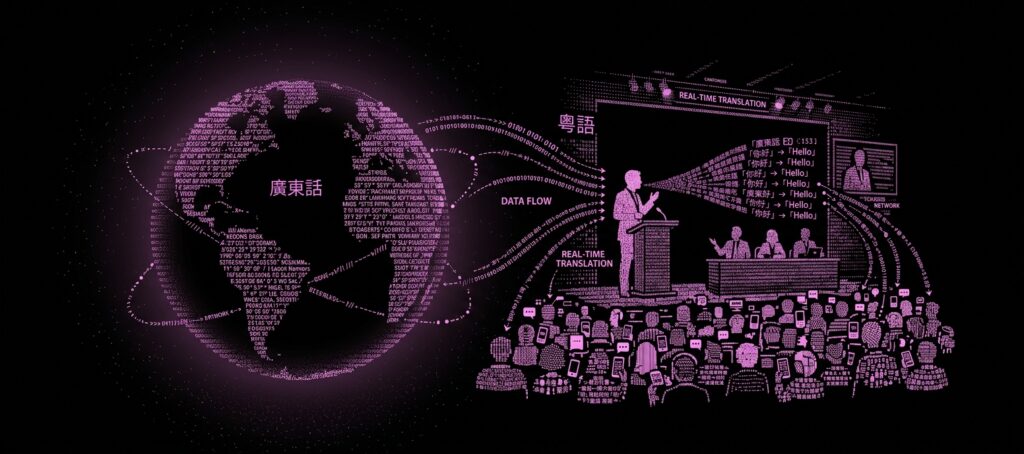
The Hong Kong Convention and Exhibition Centre hosts roughly 1,000 events per year and welcomes over 7 million attendees (HKCEC, 2025), and the language question at nearly every one of them is more complicated than outsiders assume. Hong Kong does not run on Mandarin. It does not run on English alone. It runs on Cantonese, the mother tongue of 96% of the local population (Languages of Hong Kong, Census and Statistics Department), and getting the language wrong at a Hong Kong event does not just create confusion. It creates alienation.
Cantonese event translation sits at a critical intersection: a language spoken by over 85 million people worldwide (Ethnologue, 2024), anchored in one of Asia’s most important event cities, and surrounded by a Greater Bay Area economy of 87 million residents generating over RMB 14.5 trillion in annual GDP (GBA Official Portal, 2024). For event organizers working in this region, understanding why Cantonese is not Mandarin, and why that distinction determines whether your audience trusts you or tunes out, is not optional. It is foundational.
Hong Kong: Asia’s Premier Event City and a Cantonese Stronghold
Hong Kong’s position as a MICE powerhouse is not a legacy claim. In 2025, the Hong Kong Tourism Board facilitated over 60 large-scale international MICE events slated for 2024 through 2026, projected to attract more than 183,000 high-value overnight MICE visitors generating approximately HK$1.4 billion in spending (HKTB, 2025). MICE arrivals recovered to about 80% of pre-pandemic 2018 levels by mid-2024, making it the fastest-recovering visitor segment in Hong Kong.
The city’s event infrastructure is world-class. The HKCEC on Victoria Harbour offers 91,500 square metres of rentable space, six purpose-built exhibition halls with 66,000 square metres, 52 meeting rooms, and capacity for up to 20,000 delegates (HKCEC). AsiaWorld-Expo near the airport is undergoing major expansion, further cementing Hong Kong’s position as a gateway for business events.
The trilingual reality: A typical Hong Kong conference operates with Cantonese as the default spoken language among local attendees, English as the lingua franca for international delegates and formal presentations, and Mandarin increasingly present as mainland Chinese participation grows. Getting the translation architecture wrong undermines the entire event experience.
The Events That Define Hong Kong’s Calendar
Asian Financial Forum (AFF). Co-organised by the Hong Kong SAR Government and the HKTDC, the 19th AFF in January 2026 brought over 3,600 participants from more than 60 countries to the HKCEC, with 140-plus financial officials and business leaders as speakers (HKTDC Media Room, 2026). Three-language simultaneous interpretation is standard.
RISE Conference. Produced by the team behind Web Summit and Collision, RISE draws the Asia-Pacific technology community. Cantonese matters not for the main stage but for the networking floors, satellite events, and local media coverage.
HKTDC Hong Kong International Jewellery Show. Running in both March and September across the HKCEC and AsiaWorld-Expo, these events are among the world’s largest jewellery trade fairs. Buyers negotiate in Cantonese, Mandarin, and English, and the distinction between the first two matters enormously when building trust with Hong Kong and Guangdong-based suppliers.
Art Basel Hong Kong. One of three Art Basel fairs worldwide, the Hong Kong edition draws international collectors, galleries, and curators alongside a thriving local art community. Gallery talks and collector dinners frequently happen in Cantonese among local participants.
Why Cantonese Is Not Mandarin, and Why That Matters at Events
This is the single most important thing event organizers working in Hong Kong need to understand: Cantonese and Mandarin are not dialects of each other. They are mutually unintelligible spoken languages, comparable in difference to Spanish and Italian (Simon & Simon International, 2025). They share a writing system (with Hong Kong using Traditional Chinese characters rather than the Simplified Chinese used on the mainland), but in spoken form, a Cantonese speaker and a Mandarin speaker cannot understand each other without training.
- Defaulting to Mandarin at a Hong Kong event signals that you do not understand your audience. It can feel patronizing or politically tone-deaf. Offering Cantonese interpretation shows respect for local culture.
- Networking and deal-making happen in Cantonese. Even at events where the mainstage runs in English, the real business happens in Cantonese among local attendees.
- Mainland Chinese delegates need Mandarin, not Cantonese. The trilingual reality of Hong Kong events (Cantonese, Mandarin, English) is not a nice-to-have. It is the baseline.
The Linguistic Challenge: Six Tones, Sentence Particles, and a Spoken Culture
- A complex tonal system. Cantonese has six phonemic tones (sometimes described as nine in traditional linguistics), compared to Mandarin’s four. Using the wrong tone produces a different word entirely. For real-time transcription and AI-powered captioning, this tonal density requires significantly more acoustic precision than Mandarin.
- Sentence-final particles that carry meaning. Cantonese uses a rich system of sentence-ending particles that convey attitude, certainty, emotion, or social relationship. Translation that strips them out loses the speaker’s tone and intent (1StopAsia, 2025).
- A predominantly spoken language. Written Cantonese exists but is generally used in informal contexts. Formal written Chinese in Hong Kong uses a style closer to Standard Written Chinese (which aligns more with Mandarin grammar). Live Cantonese speech needs to be rendered in a written form that Cantonese readers find natural.
- Homophones. Cantonese has an exceptionally high number of homophones. Disambiguation in real-time transcription requires context-aware processing, not just phonetic matching.
The Greater Bay Area: 87 Million Cantonese Speakers Next Door
The Guangdong-Hong Kong-Macao Greater Bay Area (GBA) encompasses nine Guangdong cities plus the two Special Administrative Regions of Hong Kong and Macau. Total population: approximately 87 million. Total GDP: over RMB 14.5 trillion in 2024 (GBA Official Portal). Cantonese is the traditional language of this entire region.
Guangzhou, historically known as Canton, is a major event city in its own right. The Canton Fair (China Import and Export Fair), held biannually, is the largest trade fair in China and one of the largest in the world. A conference in Hong Kong draws attendees from Shenzhen (20 minutes by high-speed rail), Guangzhou (48 minutes), and across the Pearl River Delta. These attendees speak Cantonese natively. They expect Cantonese language support.
Industries Driving Cantonese Event Demand
Finance & Fintech
Hong Kong is Asia’s leading financial centre. The Asian Financial Forum, Hong Kong Fintech Week, and dozens of banking conferences generate constant demand for Cantonese-English financial interpretation. Technical financial vocabulary in Cantonese diverges from Mandarin financial terminology.
Trade & Manufacturing
The HKTDC’s calendar of trade fairs (jewellery, electronics, lighting, toys, gifts, fashion) serves as the B2B marketplace for manufacturers across the Pearl River Delta. Floor-level negotiation runs on Cantonese between Hong Kong buyers and Guangdong suppliers.
Art & Culture
Art Basel Hong Kong, the Hong Kong International Film Festival, and the city’s growing gallery scene attract a bilingual Cantonese-English audience. Collector events and artist talks frequently switch between languages mid-conversation.
Technology
RISE, Startmeup HK Festival, and Hong Kong’s role as a launchpad for Greater China tech companies create demand for tech-focused Cantonese-English interpretation, particularly for demo days, pitch events, and investor roundtables.
A Scenario: The Trilingual Conference at HKCEC
Consider this: you are organizing a two-day financial technology summit at the HKCEC. Expected attendance is 1,800 delegates: 50% from Hong Kong (Cantonese-speaking), 25% from mainland China (Mandarin-speaking), and 25% international (English-speaking). Day one features a keynote by Hong Kong’s Secretary for Financial Services in Cantonese and a panel of mainland Chinese fintech CEOs presenting in Mandarin. Day two opens with an American venture capitalist keynoting in English.
Traditional interpretation requires three booths (Cantonese-English, Mandarin-English, Cantonese-Mandarin), a minimum of six interpreters, and a separate captioning team. Cost: easily HK$350,000 to HK$500,000 for two days, plus weeks of lead time to find interpreters qualified in financial technology terminology across all three languages.
How Snapsight handles this: Real-time transcription captures each session in its source language (Cantonese, Mandarin, or English) and delivers live translation to every attendee’s device. After the summit, the Analyst Agent synthesizes insights across all sessions, regardless of source language, into cross-session intelligence reports. Hong Kong delegates receive summaries in Traditional Chinese. Mainland delegates receive them in Simplified Chinese. International attendees receive them in English.
With 627 events and over 10,415 sessions processed across 75+ languages, Snapsight handles the trilingual complexity that defines Hong Kong events. The Operator Agent manages session capture autonomously at 91% autonomous operation.
Cultural Considerations for Hong Kong Events
- Code-switching is normal. Hong Kong professionals routinely switch between Cantonese and English within the same sentence. Your translation technology needs to handle mixed-language input gracefully.
- Formality expectations vary by audience. Government and banking events lean formal. Startup and tech events are considerably more casual.
- Calendar awareness. Lunar New Year, the Ching Ming Festival, and other traditional holidays affect event scheduling. Autumn (September through November) is peak conference season.
- Networking is relationship-driven. Dinners, tea meetings, and post-event gatherings are where deals happen. Language support that ends when the formal programme ends misses critical business interactions.
Frequently Asked Questions
Cantonese is the primary spoken language of Hong Kong, used by approximately 96% of the population in daily life and business. While Mandarin proficiency is increasing, especially in cross-border commerce and finance, Cantonese remains the language of trust and informal exchange. Most Hong Kong events require Cantonese as the baseline, with Mandarin and English as additional languages for mainland Chinese and international attendees respectively.
Cantonese has six phonemic tones compared to Mandarin’s four, and the wrong tone produces a completely different word. This makes acoustic processing more demanding for AI-powered transcription systems. Snapsight’s models are trained on Cantonese-specific tonal patterns and handle the language’s tonal density as part of its 75+ language support, including disambiguation of Cantonese homophones.
Yes. Cantonese and Mandarin are mutually unintelligible in spoken form. A Mandarin interpreter cannot serve Cantonese-speaking attendees, and vice versa. For events with both Hong Kong and mainland Chinese audiences, you need either separate interpretation for each language or a technology solution like Snapsight that handles multiple Chinese varieties simultaneously.
Hong Kong uses Traditional Chinese characters, while mainland China uses Simplified Chinese. For event materials, signage, and live captions, you should provide Traditional Chinese for Hong Kong and Macau audiences and Simplified Chinese for mainland attendees. Snapsight’s output can be configured for either script, ensuring each audience segment receives text in their expected written form.
The Guangdong-Hong Kong-Macao Greater Bay Area has a combined population of approximately 87 million people, with Cantonese as the traditional language across the region. Beyond the GBA, significant Cantonese-speaking communities exist in Southeast Asia (Malaysia, Vietnam, Singapore), North America, the United Kingdom, and Australia. Events targeting overseas Chinese communities frequently require Cantonese language support.