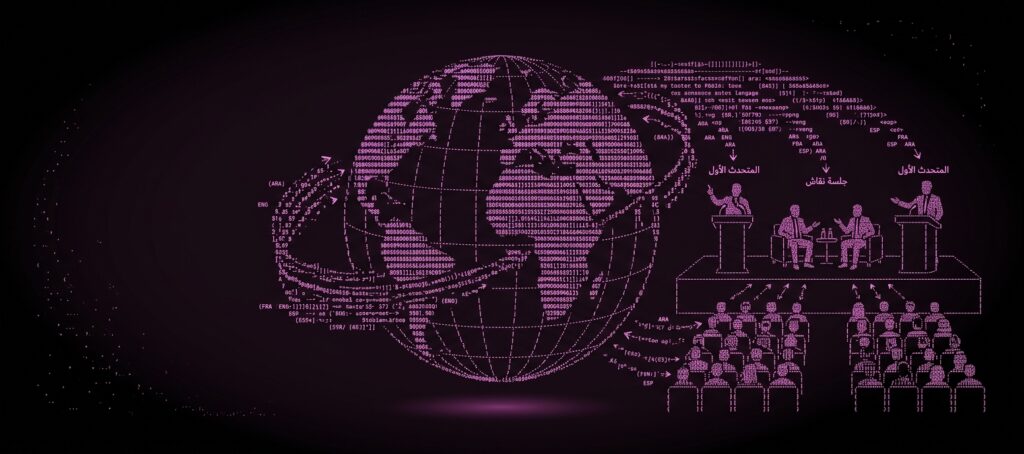
The Middle East is not preparing to become a global events hub. It already is one. The UAE MICE market reached $6.03 billion in 2025, growing at nearly 9% annually toward a projected $9.26 billion by 2030 (Mordor Intelligence). Saudi Arabia’s MICE sector, turbocharged by Vision 2030’s $800 billion infrastructure pipeline, hit $3.22 billion in 2025 and is expanding even faster at 9.93% CAGR (Mordor Intelligence). For event organizers working in this region, Arabic event translation is no longer a nice-to-have accommodation. It is a structural requirement for any conference, summit, or trade show that expects to operate credibly across the Gulf, Levant, and North Africa.
What makes Arabic uniquely challenging is not just scale, though 491 million speakers across 22 countries represents an enormous audience (Worlddata.info). It is the language’s internal complexity. A Moroccan delegate and a Qatari delegate both “speak Arabic,” but their everyday dialects may be mutually unintelligible. Modern Standard Arabic bridges formal contexts, but no one actually speaks it natively. Event translation in Arabic means navigating diglossia, right-to-left script rendering, formality registers shaped by centuries of protocol, and a business culture where language carries weight far beyond its literal meaning.
The Middle East Event Boom: Why Arabic Translation Demand Is Surging
A Region Building Its Identity Through Events
The Gulf states have made a deliberate, well-funded bet that hosting world-class events is central to economic diversification. Saudi Arabia’s Vision 2030 has committed $113 billion to tourism development, and the Kingdom surpassed 100 million visits in 2023, now contributing over 10% of GDP through tourism.
The Scale of Arabic-Language Events
| Event | Location | Attendance (2025) | Sector |
|---|---|---|---|
| LEAP | Riyadh | 215,000+ | Technology |
| GITEX Global | Dubai | 200,000+ | Technology |
| ADIPEC | Abu Dhabi | 239,709 | Energy |
| Arab Health | Dubai | 60,000+ | Healthcare |
| World Governments Summit | Dubai | 6,000+ (30 heads of state) | Government |
| Future Investment Initiative | Riyadh | 7,500+ delegates | Finance/Investment |
ADIPEC 2025 closed $46 billion in cross-sector deals across 172 countries. GITEX Global draws companies from 180 countries, with 80% of participants coming from outside the UAE. Events at this scale require Arabic event translation as standard infrastructure.
The Arabic Language: What Event Organizers Must Understand
Diglossia: The Two-Layer System
Arabic operates as a diglossic system: Modern Standard Arabic (MSA, or fusha) serves as the formal written and broadcast language, while regional dialects (ammiyya) are the languages people actually speak. A keynote speaker at LEAP will likely deliver remarks in MSA, but the networking conversations that follow will happen in Gulf Arabic, Egyptian Arabic, or Levantine Arabic.
| Dialect Group | Speakers | Region | Key Differences |
|---|---|---|---|
| Egyptian Arabic | 60+ million | Egypt, Sudan | Most widely understood due to media influence |
| Gulf Arabic | 36 million | UAE, Saudi Arabia, Qatar, Bahrain, Kuwait, Oman | Influenced by Persian and Hindi loanwords |
| Levantine Arabic | 32+ million | Jordan, Lebanon, Syria, Palestine | Significant French/English loanwords |
| Maghrebi Arabic | 70+ million | Morocco, Algeria, Tunisia, Libya | Heavy French/Berber influence; often unintelligible to Gulf speakers |
| Iraqi Arabic | 30+ million | Iraq | Transitional between Gulf and Levantine |
Key insight: Event organizers who book “Arabic interpretation” without specifying which Arabic are setting themselves up for a suboptimal experience. A simultaneous interpreter at Arab Health may hear Egyptian Arabic, Gulf Arabic, and Maghrebi Arabic in the same session.
Right-to-Left Script and Bidirectional Text
Arabic is written right-to-left (RTL), which creates cascading technical challenges for event technology:
- Slide presentations must be mirrored, with text alignment and navigation elements reversed
- Live captioning displays must render RTL text correctly, including proper line-breaking
- Mixed-language content requires bidirectional (BiDi) text handling
- Arabic typography uses connected script with position-dependent letter forms
- UI elements must be mirrored for Arabic-reading audiences
Snapsight’s platform handles RTL rendering natively, including bidirectional text mixing for the English-Arabic code-switching that is pervasive at Gulf conferences.
Key Industries Driving Arabic Event Translation Demand
Energy & Petrochemicals
The Gulf produces approximately 30% of the world’s crude oil. ADIPEC is the world’s largest energy conference with 239,709 attendees and $46 billion in deals.
Technology & Digital Transformation
Saudi Arabia and the UAE are investing tens of billions in AI and cloud infrastructure. LEAP has grown into the world’s most-attended technology event.
Healthcare & Life Sciences
Arab Health, now in its fifth decade, is the Middle East’s largest medical trade show with 60,000+ attendees.
Finance & Investment
GCC sovereign wealth funds collectively valued at over $4 trillion. Financial conferences across DIFC, ADGM, and Riyadh’s King Abdullah Financial District.
Gulf Business Culture: What Event Organizers Need to Know
Hospitality as protocol: Offering Arabic coffee (qahwa) and dates at event registration is expected, not optional. The quality of hospitality signals the seriousness of the relationship.
Relationship before transaction: Business in the Arab world is relationship-driven. Arabic translation during networking and informal sessions, not just during keynotes, reflects an understanding of how business actually happens in the region.
Calendar considerations: Ramadan shifts the entire business calendar. In 2026, Ramadan is expected to begin in late February, making March events in the Gulf sensitive to fasting schedules. Friday-Saturday weekends apply in most Gulf states (the UAE shifted to Saturday-Sunday in 2022).
How Snapsight Handles Arabic Event Translation
Traditional Arabic event translation relies on human simultaneous interpreters, typically teams of two rotating every 20-30 minutes. This model works for plenary sessions but breaks down at scale: a conference with 50 concurrent breakout sessions cannot staff 100 Arabic interpreters.
Snapsight approaches this differently. The platform provides AI-powered Arabic transcription and translation across all sessions simultaneously, delivering real-time captions and translated text to attendees’ devices. Specifically:
- Dialect awareness: the platform handles MSA and recognizes common dialectal patterns
- RTL rendering: native right-to-left text display with proper bidirectional handling
- Cross-session intelligence: Snapsight’s Analyst Agent synthesizes content across all sessions, delivering summaries in Arabic
- Scale: 10,415+ sessions processed across 627+ events, 75+ languages supported
- Autonomous operation: 91% autonomy, joining and leaving sessions automatically based on the event agenda
Frequently Asked Questions
For formal event content (keynotes, panel sessions, official communications), use Modern Standard Arabic (MSA). It is universally understood by educated Arabic speakers. For networking sessions, Gulf Arabic is appropriate in Dubai and Abu Dhabi, while Egyptian Arabic is the most widely understood colloquial dialect. Snapsight handles MSA as the default and accommodates dialectal variation.
RTL text requires event technology that renders Arabic script correctly, including connected letter forms, proper line-breaking, and bidirectional handling for mixed Arabic-English content. Many caption systems designed for Latin-script languages produce garbled Arabic text. Snapsight renders RTL natively, with seamless switching for embedded English terms, numbers, and brand names.
For high-stakes plenary sessions, VIP meetings, and diplomatically sensitive contexts, yes. Human interpreters bring cultural nuance and honorific accuracy that AI cannot fully replicate. Snapsight is designed to complement human interpreters by extending Arabic translation to the dozens or hundreds of concurrent sessions where staffing interpreters is logistically and financially impractical.
Traditional Arabic simultaneous interpretation for a single session typically requires two interpreters rotating every 20-30 minutes, plus equipment. Costs range from $2,000-$5,000 per session per day. For a 50-session conference over three days, that translates to $300,000-$750,000 in interpretation costs alone. AI-powered platforms like Snapsight offer Arabic translation across all sessions simultaneously at a fraction of this cost.